
OpenAI AI agent smartphone rumors are starting to sound less like sci‑fi and more like a serious hardware bet. Fresh analyst claims suggest OpenAI is fast-tracking a smartphone built around AI agents—meaning the experience would be task-first, not app-first. Instead of opening five different apps to complete one goal, the idea is that an AI system handles scheduling, messages, search, shopping, travel planning, and more across services with a single request.
It’s an audacious pitch because it challenges the basic structure of modern smartphones. Apple and Google built their empires on app ecosystems. Developers build the software. App stores take a cut. Users learn habits built around icons and notifications. An OpenAI AI agent smartphone would try to invert that: the assistant becomes the interface, while apps fade into the background—or become “tools” an agent calls silently.
The report trail cites well-known supply-chain analyst Ming‑Chi Kuo, who suggests mass production could happen as early as the first half of 2027, with shipments potentially reaching tens of millions across the following couple of years if everything goes to plan. Those numbers are speculative, and OpenAI hasn’t officially confirmed a phone. But even as a leak, the direction is worth taking seriously—because the smartphone market is hungry for the next interface shift, and AI is the only technology big enough to credibly trigger it.
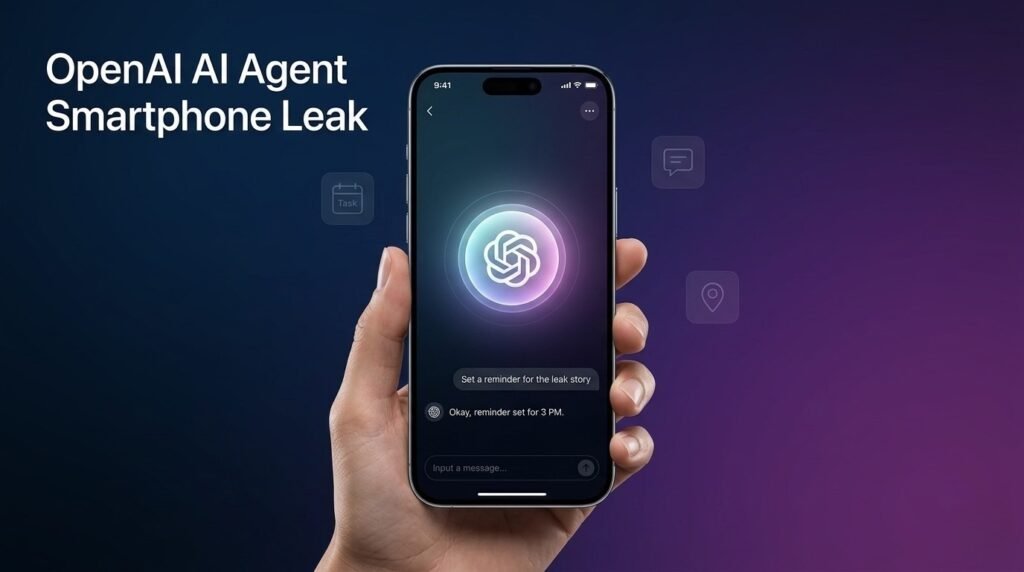
What is an OpenAI AI agent smartphone (and how it differs from today’s AI features)
Most “AI phones” right now are still traditional smartphones with AI sprinkled on top—summaries here, image edits there, assistant shortcuts in a few places. An OpenAI AI agent smartphone, as described in the leak, aims to be something more fundamental: a device where the primary interaction model is an AI agent that can take actions end-to-end.
Think less:
- “write this message for me,”
and more:
- “set up dinner with Alex next week, book a place near us, and add it to my calendar.”
To make that possible, the phone would need deep integration across communications, location context, identity, payments, and third-party services. That’s why smartphones are such an attractive platform for agents: they’re always with you, always connected, and packed with sensors and personal data signals.
The rumored hardware: MediaTek chip, dual NPUs, LPDDR6, UFS 5.0
The leak suggests OpenAI may use a custom processor built with MediaTek as the primary supplier. The chip is described as being based on a Dimensity 9600-class design and manufactured on an advanced 2nm-class process.
More interesting than the node is the architectural emphasis. The report claims the OpenAI AI agent smartphone could include:
- a dual-NPU design for heterogeneous AI workloads
- LPDDR6 memory and UFS 5.0 storage to reduce bottlenecks
- additional security measures such as virtualization-based isolation (pKVM) and inline hashing concepts
If accurate, that reads like a blueprint for always-on AI. A phone built for agents must process voice, text, and context continuously without killing battery life. That means:
- efficient local inference for lightweight tasks
- fast memory/storage for model and context handling
- secure execution for sensitive personal data
It’s also a signal that OpenAI is thinking beyond cloud-only AI. Even if the cloud handles heavy lifting, agents need local responsiveness and offline resilience.
Why OpenAI would build a phone now: control, distribution, and app-store politics
OpenAI has massive consumer reach through ChatGPT, but on mobile it still lives inside other companies’ platforms. That’s strategically uncomfortable.
An OpenAI AI agent smartphone would give OpenAI three things it can’t fully control today:
1) Hardware-software optimization for AI
If your product is an AI agent, your priorities differ from typical phone makers:
- sustained NPU performance
- microphone pipeline quality
- fast wake, low latency
- secure local storage for personal context
Owning the device lets OpenAI tune the entire stack.
2) A direct distribution channel
On iOS and Android, discovery still flows through app stores and platform rules. Hardware creates a default surface: the agent is always there, not one icon among many.
3) A new monetization layer
OpenAI could bundle subscriptions with the phone, similar to how carriers bundle plans or how other platforms bundle services. The agent becomes the reason to pay monthly, not just a nice-to-have app.
Why Android should care: agents threaten the “app economy” model
Google’s Android business isn’t only about selling Pixels. It’s about:
- search distribution
- app ecosystem gravity
- Play Store economics
- default services and data signals
If an OpenAI AI agent smartphone makes “asking the agent” the primary behavior, it could reduce:
- time spent inside apps
- dependency on search
- direct brand-to-user relationships mediated by app installs
That’s why Google is pushing Gemini so aggressively across Android—and why rumors of agent-first devices matter. The next platform battle isn’t Android vs iOS. It’s app-first platforms vs agent-first platforms.
The biggest obstacles: apps, trust, and the last-mile problem
Even if OpenAI can build the hardware, “agent phone” success hinges on problems that are brutally hard.
1) Agents must be reliably correct
If an agent books the wrong date, messages the wrong person, or buys the wrong thing, users will abandon it fast. A phone can’t be “mostly right” when it’s acting on your behalf.
2) Trust and privacy will be the make-or-break issue
An OpenAI AI agent smartphone would need deep access to messages, location, calendar, and possibly payments. That’s a trust mountain. Opt-in controls must be crystal clear, and security needs to be exceptional.
3) The ecosystem question: who integrates?
Agents need tools. If developers and services don’t integrate, the agent becomes a fancy chatbot with limited action ability. Building that ecosystem is as hard as building an app store—just different.
4) Hardware execution is not OpenAI’s core skill
Great phones require supply chain execution, quality control, service networks, and long-term support. OpenAI would need strong partners and a serious commitment to hardware ops.
What to watch next: signs the OpenAI phone is real
If the OpenAI AI agent smartphone is moving toward reality, we should see:
- more supply-chain corroboration from multiple sources
- hints of manufacturing partners and certification trails
- a clearer OS strategy (Android-based? custom? heavily modified?)
- developer tooling for “agent actions” and integrations
- demos that show real task completion, not staged prompts
Without those, it remains an intriguing leak. With them, it becomes a genuine platform threat.
Bottom line
The OpenAI AI agent smartphone leak describes an ambitious attempt to reinvent the smartphone around agents rather than apps. If OpenAI can deliver on-device intelligence, reliable action-taking, and a trustworthy privacy model, it could pressure both Android and iOS in a way that “AI features” inside existing phones can’t. But the obstacles are enormous: hardware execution, ecosystem integration, and user trust.
Even if this phone never ships, the idea is already shaping the industry. Google, Apple, Samsung, and everyone else is racing toward the same endpoint: a device where you ask for outcomes, not apps. OpenAI is simply trying to own that endpoint first.