
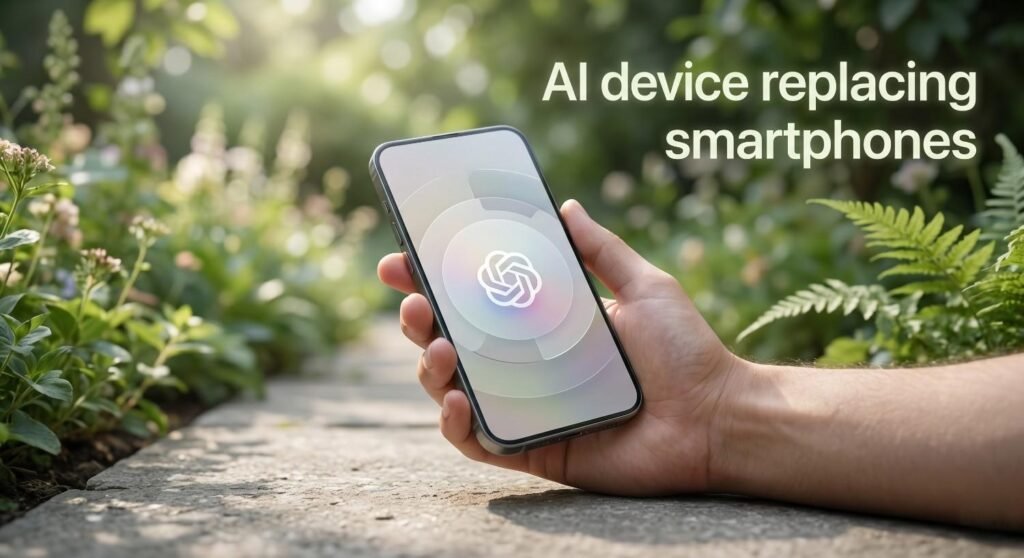
The smartphone has survived every “next big thing” prediction for almost two decades, but the conversation is shifting again—this time with far more serious money and talent behind it. The latest signals from the AI industry suggest that an AI device replacing smartphones is no longer a quirky concept pitched by startups; it is becoming the central ambition for companies that have grown tired of paying the Apple–Google toll to reach customers.
Recent reporting around OpenAI CEO Sam Altman and legendary designer Jony Ive hints at a new kind of consumer device built for the AI era—one meant to feel fundamentally different from the attention-grabbing, app-saturated smartphone experience. At the same time, Meta is pushing smart glasses harder than it ever pushed virtual reality, Amazon is retooling Alexa into a more capable assistant across speakers and wearables, and Google is expanding Gemini and building Android XR to ensure it does not lose the next computing platform to rivals.
If all of that sounds like hype, here is the reason it matters for Android users: the smartphone business is showing signs of strain. Upgrade cycles are longer, prices are rising thanks to component costs, and chip manufacturing capacity is being pulled toward AI accelerators. When the incumbent platform is no longer growing quickly, challengers smell an opening. That is why the “post-smartphone” race is back—and why it is more credible than the AI-pin fad of a few years ago.
Why the smartphone is suddenly under attack
The modern smartphone market is one of the most lucrative duopolies in tech history. Apple controls iOS and the iPhone. Google controls Android, which powers most other phones, and also sells its own Pixel devices. The two companies dominate the default gateways to the internet for billions of people.
But AI companies have a problem: they do not want to be “just another app.”
If you are OpenAI, your revenue is tied to subscriptions and enterprise deals. If you are forced to sell those subscriptions through mobile platforms, you may lose a percentage to app store fees and platform rules. Even if you avoid in-app purchases, you are still competing for attention on a screen full of icons controlled by operating system owners.
That is why the idea of an AI-first device is so seductive. If you control the hardware and the default assistant layer, you can control:
- distribution (no app store gatekeeping)
- monetization (direct subscriptions, services, commerce)
- data flows (the raw material that improves AI models)
- user behavior (how people search, shop, message, and navigate)
The dream is not simply to make a cool gadget. The dream is to own the next interface to the digital world.
What Sam Altman and Jony Ive are really signaling
Altman has compared today’s smartphone experience to walking through a sensory overload zone—bright lights, constant noise, nonstop interruptions. That is a pointed critique because it frames the phone as a problem to be solved, not a product to be improved.
Jony Ive’s involvement adds weight because he is not known for shipping half-baked consumer hardware. He helped define the iPhone era, which makes him an unusually credible figure to help design something intended to move beyond it.
What might that device look like? Based on the direction the industry is heading, an AI-native product would likely prioritize:
- voice and conversation as the primary UI
- minimal reliance on app grids and notifications
- context awareness (what you’re doing, where you are, what you need)
- fast capture (camera, microphone) with instant AI interpretation
- a “calm” interface that reduces attention traps
That does not automatically mean a screenless device. It could be screen-light. It could rely on glances rather than scrolling. It could also use a companion screen—either your phone, a wearable display, or a lightweight viewer—because many tasks still benefit from visuals.
The key point is that OpenAI and Ive appear to be aiming at a different interaction model: less tapping, more intent-driven action.
The challengers aren’t just OpenAI: Meta and Amazon want the next platform too
Meta’s smart glasses strategy is a direct smartphone challenge
Meta’s business depends on advertising and engagement. Smartphones became an uncomfortable dependency after Apple tightened tracking controls and reduced the effectiveness of cross-app ad targeting. Smart glasses offer Meta something powerful:
- a camera for capturing life moments
- an always-available assistant
- a way to deliver notifications without forcing a phone unlock
- more data signals for personalization and ads
Glasses also fit Meta’s long-term mission: keep people inside Meta-owned surfaces (messaging, feeds, social capture) without relying on iOS or Android as the main gateway.
Amazon wants ambient commerce
Amazon’s ideal device is one that makes shopping frictionless and constant. An AI-enhanced Alexa across speakers, earbuds, and glasses pushes Amazon closer to a world where you can:
- ask for product recommendations conversationally
- reorder items without opening apps
- receive shopping prompts based on context
This is not subtle: the more Amazon lives in your ear, the less it needs you to open a smartphone app.
The hidden accelerant: smartphones are getting squeezed by the AI supply chain
Even if consumers still love phones, the smartphone industry has to deal with economics.
Analysts have warned that global shipments could decline as prices rise and buyers delay upgrades. Some of that is demand fatigue, but part of it is supply and cost pressure:
- memory prices can spike when data centers absorb supply
- semiconductor foundries prioritize higher-margin AI chips
- smartphone makers lose negotiating leverage when they are not the top customers anymore
This matters because it changes the risk calculus for new device categories. If phones are not growing, investors and companies are more willing to bet on alternatives.
Why an AI device replacing smartphones is harder than it sounds
The graveyard of “phone killers” is large. The smartphone is not just a screen; it is a collection of solved problems:
- battery life
- thermal management
- cameras that work instantly
- cellular connectivity worldwide
- authentication (biometrics, passkeys)
- payments, tickets, identity
- messaging compatibility
- app ecosystems
Any new device has to answer at least some of these. The biggest constraints are physical:
Heat and battery limits are brutal in wearables
Glasses and pins sit close to your skin. They cannot run hot. They also cannot carry big batteries without becoming uncomfortable. That is why many wearables depend on a phone for heavy computation or connectivity.
Privacy concerns don’t go away
Camera-equipped glasses create immediate social friction. Past attempts failed partly because people did not want to be recorded without consent. Those concerns remain—and are arguably stronger now.
Security is a bigger issue with AI-first devices
An AI assistant that can read messages, summarize emails, book appointments, and buy products becomes a high-value target. If an attacker compromises the device—or the account behind it—the damage could be far worse than a typical app hack.
Where Google and Android fit: Android XR, Gemini, and the “assistant layer”
Google is not waiting to be disrupted. It is trying to make sure Android evolves into whatever comes next.
Two strategies stand out:
- Gemini everywhere: Google wants its AI to be the default intelligence across Android, and increasingly across partner ecosystems. The more Gemini is embedded, the more Google protects its role as the interface to information.
- Android XR: a platform designed for headsets and smart glasses, built with partners like Samsung and others, signals that Google expects “post-phone” devices to be real—and it wants them to run Google software.
For Android users, this could mean a future where your phone is still essential but becomes more like a hub—a compute and connectivity anchor that powers lighter devices.
The most realistic future: phones don’t die, they shrink in importance
A common mistake in tech predictions is assuming new platforms fully replace old ones. PCs did not vanish when smartphones arrived. TVs did not vanish when streaming became mainstream. Instead, behavior shifted.
A more plausible outcome is:
- you keep your phone, but you use it less
- your AI assistant handles more tasks in the background
- glasses/earbuds become the “front door” to quick interactions
- the phone becomes the screen you use when you need depth
This aligns with what chipmakers and platform executives have suggested: “edge gadgets” proliferate, but many still depend on a smartphone or companion device for computation.
What Android users should watch next
If you want to know whether the AI device race is real, track these signals:
- A credible product reveal from OpenAI/Ive that shows daily usefulness, not demos
- Carrier partnerships (cellular connectivity is a major barrier)
- Battery-life claims with real-world testing
- App ecosystem or integration story (payments, messaging, maps)
- Privacy-first hardware design (camera indicators, recording controls, consent cues)
- Google’s response in Android and Android XR features
The moment any new device can handle messaging, navigation, payments, and camera capture as smoothly as a phone, the conversation changes from “interesting” to “threatening.”
Bottom line
The push toward an AI device replacing smartphones is less about killing phones overnight and more about capturing the next interface layer—one that sits above apps and screens and turns the digital world into conversation and intent.
Smartphones remain the most capable consumer computers ever made, but they are vulnerable in two ways: they are expensive to innovate in meaningful leaps, and they are controlled by two gatekeepers whose rules frustrate everyone else. That creates the opening challengers are racing to exploit.
For Android, this could be both a risk and an opportunity. If the next platform is assistant-driven and wearable, Android’s flexibility and partner ecosystem could help it spread. But if a rival controls the new device category end-to-end, Android may face its biggest challenge since the iPhone era began.