
How display adhesive layers work is a foundational concept in modern display engineering, yet it often goes unnoticed by end users. Every time you interact with a smartphone, tablet, or high-resolution monitor, you are engaging with a precisely engineered stack of materials—held together by advanced adhesive technologies that do far more than simple bonding.
In today’s ultra-thin, high-performance devices, display adhesive layers are responsible for maintaining structural integrity, enhancing optical clarity, and ensuring seamless touch responsiveness. Leading manufacturers like Samsung Electronics and Apple Inc. rely heavily on these materials to deliver premium display experiences.
This in-depth guide explores how display adhesive layers function, their types, benefits, technical processes, and their growing importance in next-generation electronics.
What Are Display Adhesive Layers?
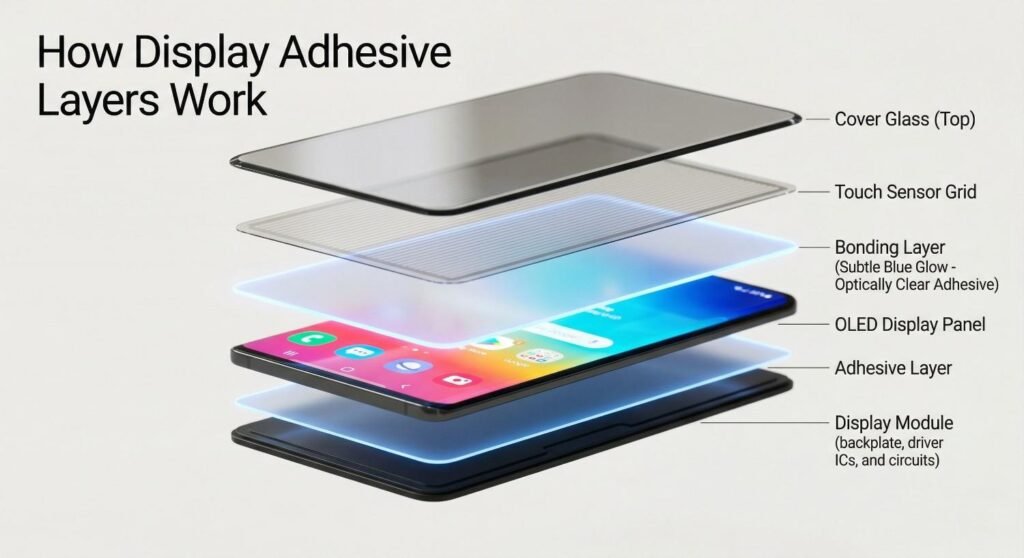
Display adhesive layers are specialized optical bonding materials used to join multiple layers within a display assembly. These typically include:
- Cover glass (protective layer)
- Touch sensor (digitizer)
- Display panel (OLED or LCD)
Unlike conventional adhesives, these materials are engineered to be optically transparent, mechanically stable, and environmentally resistant. Their primary purpose is to eliminate air gaps between layers, which significantly improves both visual performance and durability.
Key Characteristics
- High optical transparency for accurate color and brightness
- Strong adhesion across different materials (glass, plastic, metal)
- Thermal and moisture resistance for long-term reliability
- Elasticity and flexibility for modern thin and curved displays
- Longevity under stress without degradation
This YouTube video above explains a reliable method for screen repair adhesive application, focusing on achieving clean and durable results. It highlights key techniques that improve bonding and prevent common mistakes. Understanding this process helps ensure a more professional-quality screen repair.
How Display Adhesive Layers Work
Understanding how display adhesive layers work involves both physical bonding mechanisms and optical optimization principles.
Molecular Bonding Mechanism
At a microscopic level, display adhesives create bonds through:
- Van der Waals forces
- Chemical adhesion between surfaces
- Mechanical interlocking at micro-scale imperfections
This ensures a uniform and storng bond across the entire display surface, preventing delamination over time.
Optical Enhancement Principle
One of the most critical roles of adhesive layers is eliminating air gaps. Air has a different refractive index than glass, which causes:
- Light scattering
- Internal reflections
- Reduced brightness
By replacing air with an optically clear adhesive, light passes through layers more efficiently, resulting in:
- Higher contrast
- Improved brightness
- Better outdoor visibility
Step-by-Step Bonding Process
- Surface Preparation
All layers are cleaned using anti-static and dust-removal techniques to ensure contamination-free bonding. - Adhesive Application
The adhesive is applied either as a solid film (OCA) or a liquid (LOCA) depending on the application. - Precision Alignment
Layers are aligned using high-accuracy machines to ensure perfect positioning. - Curing Process
Adhesives are cured using:- UV light (for LOCA)
- Pressure or heat (for OCA)
- Final Integration
The bonded structure forms a single unified display module with enhanced performance.
Types of Display Adhesive Layers
Different display technologies require different adhesive solutions. The most commonly used types include:
Optically Clear Adhesive (OCA)
OCA is a pre-formed solid adhesive film that offers:
- Uniform thickness
- Clean application
- High reliability
It is widely used in mass production due to its consistency and ease of handling.
Liquid Optically Clear Adhesive (LOCA)
LOCA is a liquid adhesive applied directly between layers and cured using UV light.
Advantages:
- Excellent gap filling
- Superior optical clarity
- Ideal for curved or uneven surfaces
Pressure Sensitive Adhesive (PSA)
PSA is used in less complex applications and relies on pressure for bonding rather than curing.
Typical Use Cases:
- Entry-level devices
- Non-critical display components
OCA vs LOCA Adhesives
| Feature | OCA (Optically Clear Adhesive) | LOCA (Liquid Optically Clear Adhesive) |
|---|---|---|
| Form | Solid film | Liquid |
| Application | Pre-cut sheets | Dispensed liquid |
| Gap Filling | Limited | Excellent |
| Optical Clarity | High | Very high |
| Repair Complexity | Easier | More complex |
| Cost | Moderate | Higher |
Key Insight
LOCA provides superior optical integration, while OCA offers ease of manufacturing and repair—making both essential in different production scenarios.
Role of Display Adhesive Layers in Screen Performance
The performance of modern displays is heavily influenced by how effectively adhesive layers function.
Improved Visibility
By reducing internal reflections, adhesives significantly enhance:
- Screen brightness
- Contrast levels
- Outdoor readability
Enhanced Touch Sensitivity
Eliminating gaps ensures that touch input is:
- More accurate
- Faster
- Better aligned with visual output
Structural Strength
Adhesives act as a binding backbone, improving resistance to:
- Impact
- Bending
- Layer separation
Enabling Slim Designs
Without adhesive bonding, modern ultra-thin smartphones would not be possible. These materials allow:
- Reduced thickness
- Lightweight construction
- Seamless integration
Benefits of Display Adhesive Layers
1. Enhanced Optical Clarity
Adhesive layers eliminate refractive mismatches, ensuring a sharper and more vibrant display.
2. Increased Durability
They strengthen the overall structure, reducing the risk of internal damage.
3. Better Sunlight Readability
Reduced reflections lead to improved performance in bright environments.
4. Reduced Parallax Effect
By minimizing the gap between touch layer and display, the perceived distance between input and output is reduced.
5. Improved Touch Accuracy
This results in a smoother and more precise user experience.
Common Challenges in Display Adhesive Layers
Despite their advantages, adhesive layers introduce technical challenges.
Bubble Formation
Air bubbles trapped during application can:
- Distort visuals
- Reduce bonding strength
Dust Contamination
Even microscopic particles can lead to:
- Visible defects
- Weak adhesion
Curing Errors
Incorrect curing conditions may result in:
- Incomplete bonding
- Reduced durability
Factors Affecting Adhesive Performance
Material Quality
Premium adhesives provide better:
- Transparency
- Longevity
- Mechanical strength
Application Precision
Even slight misalignment can impact:
- Display clarity
- Touch accuracy
Environmental Conditions
Temperature and humidity directly influence:
- Adhesion strength
- Curing efficiency
Applications of Display Adhesive Layers
Smartphones and Tablets
Used extensively to bond display components for clarity and durability.
Televisions and Monitors
Enhances viewing quality and structural integrity in large panels.
Automotive Displays
Critical for infotainment systems and digital dashboards.
Wearable Devices
Supports compact designs with high durability.
Practical Tips for Handling Display Adhesive Layers
- Work in a dust-free, controlled environment
- Use precision alignment tools
- Avoid direct contact with adhesive surfaces
- Follow manufacturer-recommended curing conditions
- Select the appropriate adhesive type for your use case
Future Trends in Display Adhesive Technology
Advanced Optical Materials
Next-generation adhesives will offer:
- Higher transparency
- Better refractive matching
Flexible and Foldable Adhesives
Essential for emerging technologies like foldable smartphones.
Faster Curing Techniques
Reducing production time while maintaining quality.
Integration with New Materials
Adhesives will evolve alongside:
- MicroLED displays
- Quantum dot technologies
FAQs About How Display Adhesive Layers Work
What are display adhesive layers?
They are specialized materials used to bond display components while maintaining optical clarity and strength.
How do display adhesive layers improve screen quality?
They eliminate air gaps, reduce reflections, and enhance brightness and touch accuracy.
What is the difference between OCA and LOCA?
OCA is a solid film adhesive, while LOCA is a liquid adhesive with superior gap-filling capability.
Can display adhesive layers be replaced?
Yes, but replacement requires precision tools and controlled conditions.
Why is curing important?
Curing ensures the adhesive forms a stable, durable bond between layers.
Conclusion
How display adhesive layers work is a crucial aspect of modern display technology that directly impacts device performance, durability, and user experience. These advanced materials go far beyond simple bonding—they are engineered to optimize light transmission, improve touch responsiveness, and strengthen the entire display structure.
As devices continue to evolve toward thinner, more flexible, and more powerful designs, the role of adhesive layers will only become more significant. Innovations in optical materials, curing technologies, and flexible adhesives will shape the next generation of displays.
For engineers, technicians, and technology enthusiasts, understanding display adhesive layers is essential—not just for appreciating modern devices, but for staying ahead in an industry driven by precision and innovation.