
Ceramic shield technology explained begins with a simple reality: modern smartphones are more powerful—and more fragile—than ever before. As devices become thinner, lighter, and more visually immersive, their displays have also become larger and more exposed to accidental damage. A single drop can result in costly repairs, making durability a critical factor for both manufacturers and consumers.
To address this challenge, companies like Apple Inc. introduced Ceramic Shield, a breakthrough material designed to significantly improve screen toughness without compromising clarity or touch sensitivity. This innovation combines advanced glass engineering with ceramic science, resulting in one of the most durable smartphone display materials available today.
In this comprehensive guide, we’ll explore everything you need to know about ceramic shield technology—how it works, its structure, benefits, limitations, comparisons with other glass technologies, and what the future holds.
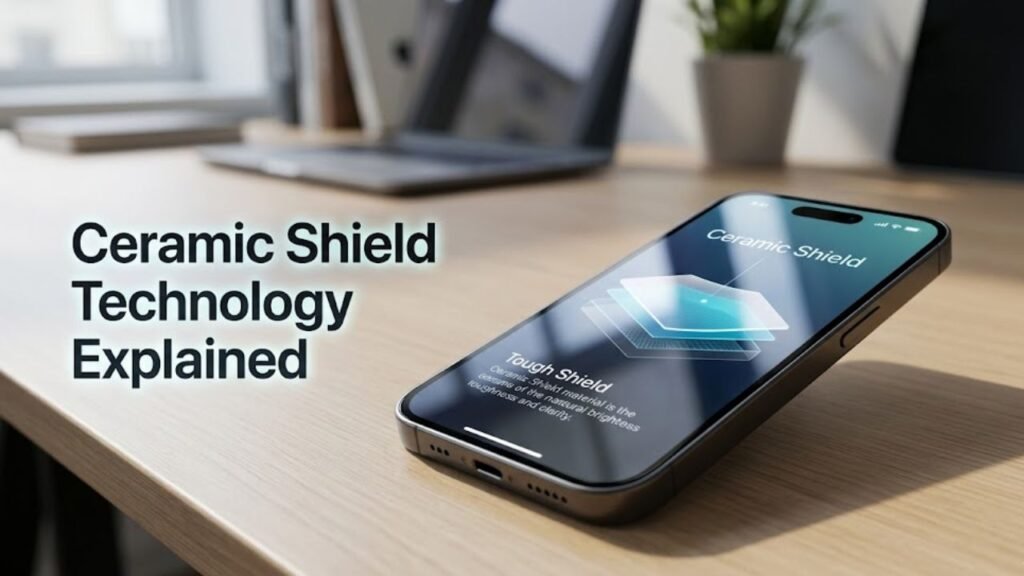
What Is Ceramic Shield Technology?
Ceramic shield technology is a hybrid material that blends traditional glass with nano-sized ceramic crystals. Unlike conventional smartphone glass, which is purely silica-based, ceramic shield integrates these crystals into the glass matrix to enhance mechanical strength.
The most well-known implementation of this technology is Ceramic Shield, which debuted in flagship smartphones and quickly set a new benchmark for drop resistance.
Key Characteristics
- Nano-ceramic crystal infusion for structural reinforcement
- High optical transparency for display clarity
- Improved drop performance compared to standard glass
- Maintained touch sensitivity for smooth user interaction
- Enhanced durability without increasing thickness
This combination makes ceramic shield a unique solution that bridges the gap between strength and usability.
This YouTube video below tests how tough the iPhone 12 Ceramic Shield glass really is, including extreme durability experiments like waterjet cutting. It shows that while the glass is significantly stronger and more drop-resistant, it is not indestructible under extreme conditions. Understanding these tests helps put real-world durability into perspective.
How Ceramic Shield Technology Works
To fully understand ceramic shield technology explained at a technical level, we need to look at its manufacturing and structural engineering.
1. Nano-Ceramic Crystal Infusion
During production, microscopic ceramic crystals are embedded into molten glass. These crystals are:
- Uniformly distributed
- Extremely small (nano-scale)
- Structurally stronger than glass
This creates a composite material that retains the transparency of glass but gains the toughness of ceramics.
2. High-Temperature Heat Treatment
The infused material undergoes a controlled heat treatment process, which:
- Strengthens chemical bonds
- Fuses ceramic and glass components
- Improves resistance to stress and impact
This step is crucial in ensuring the material behaves as a single मजबूत, cohesive structure.
3. Crack Prevention Mechanism
One of the biggest weaknesses of traditional glass is crack propagation—once a crack starts, it spreads rapidly.
Ceramic shield solves this by:
- Disrupting crack pathways
- Absorbing and redistributing stress
- Preventing fractures from spreading easily
This dramatically improves drop resistance, which is the primary advantage of this technology.
Structure of Ceramic Shield Glass
Ceramic shield is not just a single layer—it’s part of a multi-layer display system designed for performance and durability.
Layer Composition
- Outer Ceramic-Infused Glass Layer
- First line of defense
- Provides impact resistance
- Reinforced Structural Layer
- Supports internal strength
- Enhances durability
- Touch Sensor Layer
- Detects user input
- Maintains responsiveness
- Display Panel (OLED/LCD)
- Produces visuals
- Responsible for brightness and color
Each layer plays a specific role, ensuring the device remains both durable and responsive.
Benefits of Ceramic Shield Technology
1. Superior Drop Protection
The biggest advantage is drop performance. Ceramic shield can significantly reduce the chances of screen breakage during accidental falls.
2. Increased Toughness
The addition of ceramic crystals strengthens the internal structure, making it more resistant to stress.
3. Long-Term Durability
Unlike standard glass, ceramic shield maintains its integrity over time, even with daily wear.
4. High Optical Clarity
Despite added strength, it remains:
- Clear
- Bright
- Color-accurate
There is no compromise in display quality.
5. Lightweight Design
Even with enhanced strength, ceramic shield remains lightweight—critical for modern slim smartphones.
6. Improved User Confidence
Users can handle their devices with less fear of accidental damage, improving overall experience.
Ceramic Shield vs Traditional Glass
| Feature | Ceramic Shield | Traditional Glass |
|---|---|---|
| Drop Resistance | Very High | Moderate |
| Durability | Enhanced | Standard |
| Scratch Resistance | Moderate | Moderate |
| Weight | Lightweight | Lightweight |
| Technology | Ceramic-infused | Pure glass |
Key Insight
Traditional glass focuses on clarity and basic durability, while ceramic shield is engineered specifically to withstand impacts.
Ceramic Shield vs Gorilla Glass
This YouTube video below compares Gorilla Glass, Ceramic Shield, and Kunlun glass, highlighting the key differences in strength, durability, and drop resistance. It gives a practical look at how each performs in real-world conditions. Understanding these differences helps in choosing better device protection.
Another major competitor in smartphone glass technology is Gorilla Glass.
Core Differences
- Ceramic Shield
- Focus: Drop protection
- Technology: Ceramic crystal infusion
- Gorilla Glass
- Focus: Scratch resistance and flexibility
- Technology: Chemical strengthening (ion exchange process)
Which Is Better?
- Choose ceramic shield if you prioritize drop resistance
- Choose Gorilla Glass if you want better scratch resistance
Both are advanced, but they solve slightly different problems.
Limitations of Ceramic Shield Technology
No material is perfect—and ceramic shield has its trade-offs.
1. Scratch Resistance Is Not Superior
Despite being stronger, it does not significantly outperform other premium glass in resisting scratches.
2. Higher Cost
The complex manufacturing process increases production costs, making it more expensive.
3. Not Shatterproof
While tougher, it is not unbreakable. Extreme impacts can still cause damage.
Applications of Ceramic Shield Technology
Smartphones
Primarily used in flagship smartphones to provide enhanced display protection.
Wearable Devices
Smartwatches benefit from ceramic shield due to their exposure to daily wear.
Future Applications
Potential expansion into:
- Tablets
- Laptops
- Automotive displays
- AR/VR devices
Factors That Affect Ceramic Shield Performance
Even the strongest glass depends on real-world conditions.
1. Impact Angle
- Flat drops → better resistance
- Corner impacts → higher risk of damage
2. Surface Type
- Soft surfaces → safer
- Hard surfaces (concrete, tiles) → خطر
3. Device Design
- Strong frames absorb shock
- Weak frames transfer force to the glass
Practical Tips to Protect Ceramic Shield Displays
Even with advanced protection, extra care goes a long way.
- Use a high-quality protective case
- Avoid dropping the device on hard surfaces
- Apply a screen protector for scratch prevention
- Keep the screen clean to avoid micro-abrasions
- Avoid placing the phone with keys or coins
Future Innovations in Ceramic Shield Technology
The evolution of ceramic shield is far from over.
1. Improved Scratch Resistance
Future versions may combine ceramic strength with higher surface hardness.
2. Advanced Nano-Engineering
Better crystal distribution could further enhance durability.
3. Wider Industry Adoption
More manufacturers are expected to adopt ceramic-based glass solutions.
4. Hybrid Materials
Next-gen displays may combine:
- Ceramic
- Sapphire
- Advanced polymers
FAQs About Ceramic Shield Technology Explained
What is ceramic shield technology?
It is a glass material infused with ceramic crystals to improve durability and drop resistance.
Is ceramic shield better than Gorilla Glass?
It offers better drop protection, while Gorilla Glass may provide better scratch resistance.
Can ceramic shield prevent all damage?
No. It reduces risk but does not make screens unbreakable.
Does ceramic shield affect display quality?
No. It maintains excellent clarity, brightness, and touch responsiveness.
Should I still use a screen protector?
Yes. It helps protect against scratches and minor damage.
Conclusion
Ceramic shield technology explained in depth reveals a major leap forward in smartphone durability. By combining the strength of ceramics with the clarity of glass, it addresses one of the biggest pain points in modern devices—screen damage.
While it is not completely scratch-proof or shatterproof, its exceptional drop resistance makes it one of the most reliable display protection technologies available today.
As innovation continues, ceramic shield is likely to become even more advanced and widely adopted, shaping the future of durable, high-performance displays.
For users who want a balance of strength, clarity, and premium design, ceramic shield technology stands out as a smart and future-ready choice.