
Moto G87 200MP camera is not the kind of spec you expect to see leading a G‑series launch, but that’s exactly what Motorola is doing with its latest midrange/budget-leaning phone. The company is positioning the Moto G87 as a camera-forward device built for everyday buyers who want sharper photos, better low-light results, and more flexible framing—without paying flagship prices.
On paper, the Moto G87 200MP camera setup looks like Motorola is borrowing the “Ultra” playbook and shrinking it into a mainstream package: a very high-resolution primary sensor with optical image stabilization, a claimed 2x “lossless” zoom mode, and software enhancements that aim to make photos cleaner in challenging light. Motorola is also talking up multiple focal length options—24mm, 35mm, and 50mm—suggesting a more photography-minded approach than the typical “one main camera + filler sensor” formula in this price tier.
Of course, megapixels don’t guarantee quality. A 200MP sensor can be brilliant or gimmicky depending on sensor size, optics, processing, and how well the phone handles motion and dynamic range. But the overall Moto G87 package—AMOLED display, durable build, and Android 16 out of the box—makes this a phone worth watching if you care about camera performance in the affordable Android segment.
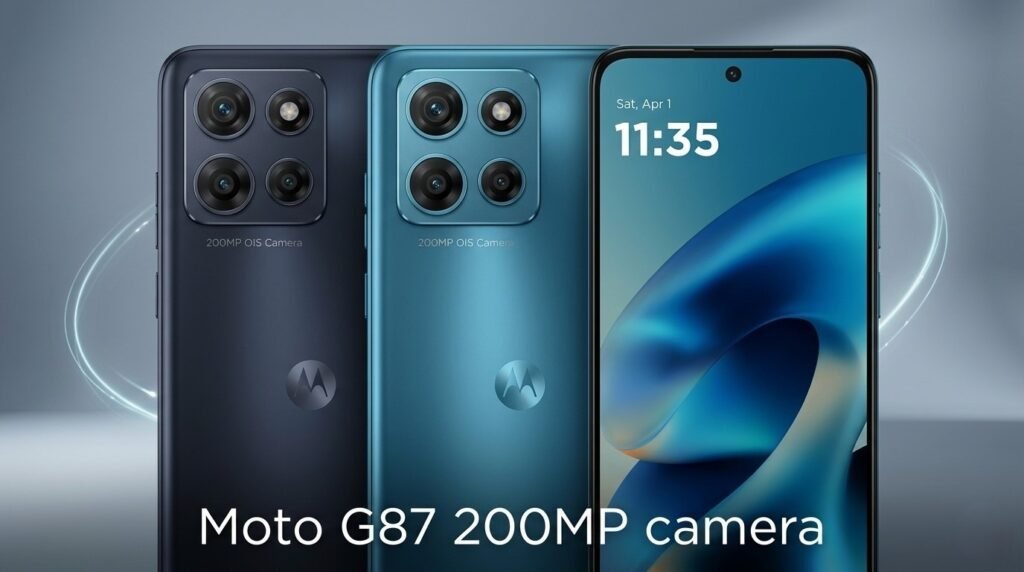
What the Moto G87 200MP camera is designed to do
Motorola’s messaging around the Moto G87 200MP camera focuses on two real-world benefits: detail and light capture. High-resolution sensors typically use pixel binning to combine multiple pixels into one “super pixel,” which can improve low-light performance and reduce noise. Motorola is branding its approach as “Ultra Pixel” technology and is making big claims about light sensitivity improvements.
What you should expect in real photos
A 200MP main camera in a budget phone is most likely intended to improve these areas:
- Better daylight detail (especially on foliage, textures, architecture)
- Cleaner digital zoom at 2x, using sensor crop rather than blurry upscaling
- More flexibility for cropping after you shoot
- Improved night shots if OIS + pixel binning + processing are tuned well
The inclusion of OIS (optical image stabilization) is arguably more important than the megapixel number for everyday users. OIS helps reduce blur in low light, improves video stability, and increases the odds of getting sharp shots indoors.
Moto G87 200MP camera features: “lossless” zoom and focal lengths explained
Motorola says the Moto G87 200MP camera supports 2x “lossless” zoom. On phones, “lossless” usually means the phone is cropping into a high-resolution sensor with enough pixels to maintain detail at 2x without relying heavily on digital sharpening.
If Motorola’s processing is competent, 2x crops from a 200MP sensor can look meaningfully better than typical budget phone zoom. The key is avoiding over-sharpened edges and smudgy textures—common weaknesses when cheaper phones push zoom beyond their comfort zone.
Motorola is also emphasizing focal length choices like 24mm, 35mm, and 50mm. That’s a photography-friendly way of framing what is likely:
- 24mm: the main camera’s standard view
- 35mm and 50mm: cropped views from the main sensor for more natural portraits and street-style shots
This approach is becoming more common in flagship phones, and it’s good to see it filtering down—assuming the Moto G87 200MP camera keeps skin tones and edges natural when cropping.
The rest of the camera system: ultrawide + selfie upgrades
Beyond the main sensor, the Moto G87 includes:
- 8MP ultrawide camera
- 32MP front camera for selfies
- AI features such as Auto Smile Capture
The 8MP ultrawide is typical for the segment. It will likely be fine in daylight and softer at night. The selfie camera resolution is competitive, and Motorola’s processing will matter more than the sensor number—especially for portrait separation and indoor color accuracy.
If Motorola wants the Moto G87 200MP camera story to feel credible, it needs consistency: not just a great main camera, but predictable HDR, reliable autofocus, and fast shutter response for moving subjects.
Display and performance: AMOLED, 120Hz, and Dimensity 6400
Camera hype only works if the rest of the phone isn’t frustrating. The Moto G87 appears well-rounded for its tier:
- 6.78-inch AMOLED display
- 1.5K resolution
- 120Hz refresh rate
- claimed very high peak brightness
- Gorilla Glass 7i protection
- MediaTek Dimensity 6400 chipset
- up to 12GB RAM
This should translate into a phone that feels smooth for everyday use—scrolling, social apps, video, and casual gaming. The Dimensity 6400 isn’t marketed as a gaming monster, but it’s typically adequate for mainstream workloads.
Battery and charging: solid, but not chasing extremes
Motorola lists:
- 5,200mAh battery
- 30W wired charging
That’s a sensible combination. It won’t win a charging-speed race, but with an efficient OLED panel and midrange silicon, battery life should be strong for most users. The bigger question is how well the Moto G87 200MP camera processing is optimized—camera pipelines can draw significant power during heavy shooting and video.
Durability: IP ratings and MIL certification on a budget phone
One of the most impressive parts of this launch is durability. The Moto G87 reportedly includes:
- IP66 / IP68 / IP69 dust and water resistance
- MIL‑STD‑810H certification
- drop resistance claims around 1.2 meters
Those are flagship-style durability talking points in a more affordable line. If accurate, it means Motorola is aiming the Moto G87 at people who want a phone they can actually use without babying—commuters, travelers, outdoor users, and anyone tired of fragile glass slabs.
Software and availability: Android 16 out of the box
The Moto G87 ships with Android 16, which is important for longevity. Motorola hasn’t disclosed pricing at the time of the report, but the rollout is expected across:
- Europe
- Middle East
- Africa
- Latin America
Other markets may follow later.
Bottom line
The Moto G87 200MP camera is a bold move for Motorola’s budget-oriented G-series, and it signals a shift: Motorola wants camera hardware to be a primary reason to buy its affordable phones, not just a checkbox. With OIS, a 2x crop zoom promise, and focal-length framing options, the G87 has the ingredients to deliver better everyday photography than typical budget rivals—if Motorola’s processing holds up.
Still, the verdict will come from real-world samples: how it handles indoor motion, night scenes, skin tones, and dynamic range. If Motorola nails those, the Moto G87 could become one of the more compelling “camera-first” affordable Android phones in its release markets.