
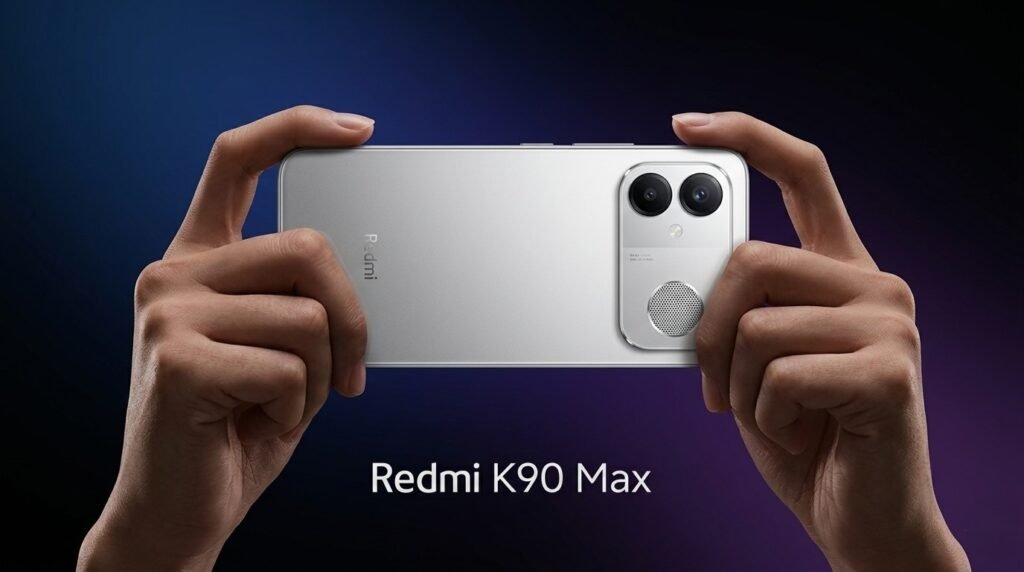
Redmi K90 Max cooling fan is the headline feature Xiaomi wants you to talk about—and it’s easy to see why. With the K90 Max, Redmi has launched its first phone with an active cooling system built into the chassis, a move that pulls the brand closer to dedicated gaming phones like ASUS ROG while still keeping the rest of the device recognizable as a mainstream performance flagship.
The pitch is simple: mobile chips are getting faster, games are getting heavier, and sustained performance is now the difference between “smooth for five minutes” and “smooth for an entire match.” A Redmi K90 Max cooling fan is Xiaomi’s answer to thermal throttling, and the company is backing it with a large fan design, multiple fan modes, and claimed temperature drops that sound more like a gaming laptop spec sheet than a typical smartphone launch.
Beyond the fan, the Redmi K90 Max cooling fan debuts as Xiaomi’s first built-in fan phone is stacked with the usual high-end performance parts: MediaTek’s Dimensity 9500, fast LPDDR5X-class memory, UFS 4.1 storage, a 165Hz display, and a very large battery with 100W charging. It’s a clear “performance-first” phone—just with a new, unusual mechanism for keeping performance stable.
Why a Redmi K90 Max cooling fan is a big deal for phones
Smartphones have always struggled with heat. They’re thin, sealed, and designed to be held in the hand—not to exhaust hot air. When a chip gets too warm, the system typically responds by reducing clock speeds to protect the battery and internal components. That’s thermal throttling, and it shows up as:
- frame-rate drops in games
- stutters during camera recording
- reduced sustained benchmark scores
- warmer surfaces that feel uncomfortable
- slower charging during heavy use
Vapor chambers and graphite sheets can spread heat, but they can’t remove it as effectively as active airflow. That’s why gaming phones have experimented with fans for years, and why the Redmi K90 Max cooling fan is such an interesting turning point: Xiaomi is bringing active cooling to a Redmi flagship-tier device, not just a niche gaming brand.
How the built-in fan works (and Xiaomi’s claimed results)
Xiaomi says the Redmi K90 Max cooling fan debuts as Xiaomi’s first built-in fan phone uses an internal fan system designed around efficient airflow, not just a tiny spinner thrown inside the frame.
Key hardware details highlighted include:
- an 18.1mm fan diameter (positioned as larger than typical implementations)
- a vertical air intake design
- forward-leaning blades aimed at pushing air more efficiently
- a sealed air duct and vortex-style airflow design to reduce turbulence
In Xiaomi’s internal testing, the system is claimed to reduce temperatures by up to 10°C in around 100 seconds. If that’s even partially true in real-world use, it could be meaningful for gaming stability—especially in warmer climates where phones throttle more aggressively.
Fan modes and noise
The Redmi K90 Max cooling fan reportedly supports three adjustable fan modes, with noise levels peaking around 32dB. That number suggests the fan should be audible in a quiet room but not obnoxious—though real-world perception will vary depending on pitch and whether you’re gaming with speakers or earbuds.
Longevity claims and warranty
Xiaomi also emphasizes durability:
- an all-metal bearing system
- a 50,000-hour aging test claim
- a special early-buyer warranty offer for the fan (plus cleaning perks)
For active cooling to go mainstream, reliability is everything. A fan that fails after a year would be a PR disaster. Xiaomi clearly knows that and is trying to pre-empt concerns.
Performance hardware: Dimensity 9500, D2 graphics chip, and 165Hz gaming focus
The Redmi K90 Max cooling fan debuts as Xiaomi’s first built-in fan phone isn’t relying on cooling alone. It’s built like a performance phone from top to bottom.
Chipset and “discrete” graphics
At the core is MediaTek Dimensity 9500, paired with an AI-focused discrete graphics chip referred to as D2. Xiaomi is positioning this combo for high refresh rate gaming, including support for:
- 1.5K resolution
- up to 165Hz in a wide range of titles (as claimed)
Whether games actually run at 165fps consistently depends on title support and thermal headroom—which is exactly where the Redmi K90 Max cooling fan comes in. If the fan keeps the chip from throttling, the phone can sustain higher frame rates longer.
RAM and storage
The Redmi K90 Max cooling fan debuts as Xiaomi’s first built-in fan phone includes:
- LPDDR5X Ultra RAM (branding suggests a top-tier bin/spec)
- UFS 4.1 storage
That’s the kind of memory stack you want for fast game loading, quick texture streaming, and responsive multitasking.
Display and battery: big screen, huge cell, fast charging
Up front, the phone reportedly features:
- 6.83-inch flat display
- 1.5K resolution
- 165Hz refresh rate
Xiaomi also highlights eye comfort features such as full-brightness DC dimming and a very low brightness mode, plus a dedicated gaming eye protection setting.
Battery is another standout:
- 8,550mAh single-cell battery
- 100W wired charging
That combination is built for long sessions. Big batteries matter more on gaming phones because high refresh and high GPU load can drain power quickly. A massive cell plus fast charging is a strong quality-of-life advantage.
Cameras and extras: not the main story, but not barebones
Camera hardware is more restrained than the performance specs:
- 50MP main camera (1/1.55-inch sensor size cited)
- 8MP ultrawide
- 20MP selfie camera
That’s fine for a performance-first device, but it signals priorities: this is not trying to be an Ultra camera flagship.
The extras, however, are clearly tuned for gaming and daily usability:
- 400Hz gyroscope sampling for more responsive motion controls
- optimized touch zones for certain games
- three-mic setup for landscape gaming audio
- signal enhancement chips for better network stability
- dual speakers tuned with Bose
- ultrasonic fingerprint sensor
- X-axis linear motor for haptics
IP ratings with a fan?
Perhaps the most surprising claim is the durability rating: IP66/IP68/IP69 levels of dust and water resistance despite having an internal fan. If Xiaomi has truly engineered sealed ducts and waterproofing for active airflow, that’s a meaningful advance. It’s also something reviewers will test aggressively.
Price: aggressive for a phone with active cooling
The Redmi K90 Max reportedly starts at 3,499 yuan (roughly $513) in China, with launch discounts potentially lowering the effective purchase price significantly depending on local subsidy programs.
If Xiaomi ever ships a variant globally under a different name, pricing will vary. But the message is clear: Xiaomi wants active cooling to feel attainable, not exotic.

Bottom line
Redmi K90 Max cooling fan could mark the start of a new phase for performance phones. Instead of relying purely on vapor chambers and software tuning, Xiaomi is adding real airflow—bringing gaming-phone ideas into a mainstream Redmi launch. Paired with Dimensity 9500, fast storage, a 165Hz display, and a huge battery, the K90 Max is designed to sustain performance rather than just peak for a benchmark screenshot.
The big questions now are the ones only real testing can answer: does the fan meaningfully prevent throttling, how loud does it feel in hand, and how does Xiaomi maintain IP-grade sealing over time? If those pieces hold up, the K90 Max won’t just be a curiosity—it could be the template other brands copy next.