
EU replaceable smartphone batteries law is set to bring back something many people thought was gone for good: phones with batteries you can swap yourself. Starting in February 2027, smartphones and tablets sold in the European Union will need to feature user-replaceable batteries, part of a broader sustainability push designed to reduce e-waste, cut long-term ownership costs, and extend the usable life of modern devices.
This is not a niche regulation aimed at budget phones. The EU replaceable smartphone batteries law will apply across the board, affecting everything from mainstream Android models to premium iPhones and high-end foldables. Because Europe is too big a market to ignore—and because global supply chains prefer one hardware design when possible—the rule is likely to influence smartphone design far beyond EU borders.
If you’ve ever delayed upgrading because your battery degraded, or paid for a costly battery service because your phone was sealed shut, this is the kind of regulation that can change the economics of owning a smartphone.
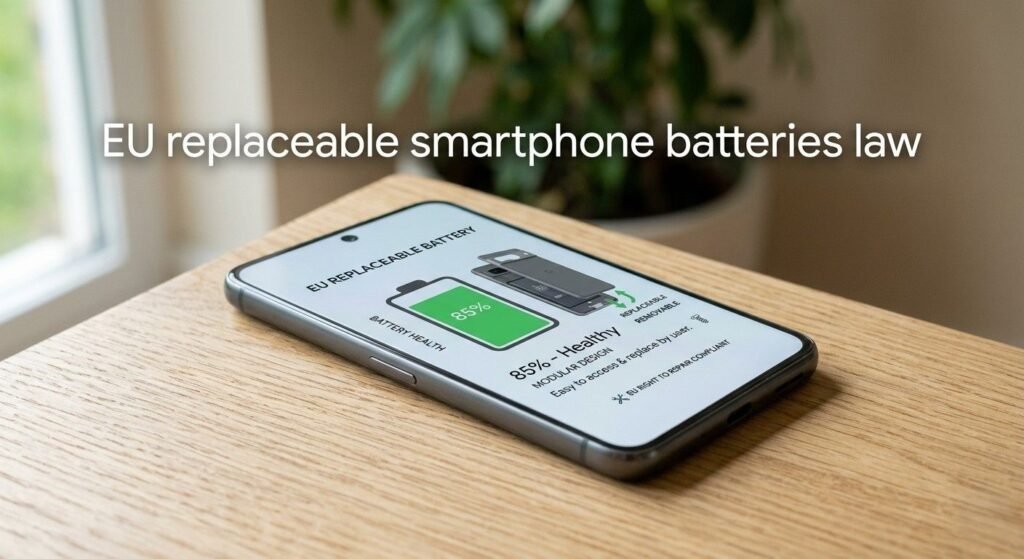
What the EU replaceable smartphone batteries law actually requires
The key requirement is straightforward: devices must be designed so that consumers can remove and replace the battery themselves.
However, the details matter. Under the EU replaceable smartphone batteries law, manufacturers are expected to ensure that replacement can be done without special tools. If tools are required, they must be supplied—typically free—at purchase. That language is aimed at eliminating repair barriers such as proprietary screws, specialized heat guns, or complicated adhesive removal that effectively forces users into paid repair channels.
Alongside the removable battery rule, the regulation also includes requirements designed to prevent “paper compliance,” where a battery is technically replaceable but practically impossible to obtain.
Replacement battery availability: the five-year expectation
Manufacturers must ensure replacement batteries remain available for several years even after a product is discontinued. The stated goal is to keep devices repairable in the real world, not just on launch day.
For consumers, that means:
- you should be able to buy an official battery later
- third-party supply may increase as demand stabilizes
- fewer phones get thrown away due to battery aging alone
The EU replaceable smartphone batteries law treats battery replacement as a core consumer right rather than a premium service.
Why the EU is doing this: e-waste, cost, and device lifespan
Smartphones are one of the world’s biggest recurring electronics purchases. The EU estimates that millions of phones and tablets are sold in the region every year, contributing to massive e-waste totals—while recycling rates remain far from ideal.
Batteries are a particularly important lever because battery health is a primary reason people replace otherwise functional phones. Most modern smartphones still work well after several years, but degraded battery capacity creates daily inconvenience:
- poor screen-on time
- sudden shutdowns
- performance throttling on older devices
- increased heat and charging cycles
The EU replaceable smartphone batteries law is designed to make “keep your phone longer” not just a slogan, but a practical choice.
EU officials also argue this will save consumers money over time by reducing forced upgrades and expensive service fees. In theory, if battery replacement becomes easier and more competitive, the cost of extending a phone’s life drops sharply.
How Android phone design could change under the EU replaceable smartphone batteries law
Android brands already ship a huge variety of devices, but most share one modern design assumption: sealed bodies for thinness, rigidity, and water resistance. The EU replaceable smartphone batteries law challenges that assumption.
Expect manufacturers to experiment with:
- modular internal frames that allow battery access without dismantling the whole phone
- new sealing systems that preserve water resistance with removable panels
- fewer permanent adhesives and more mechanical fasteners
- standardized battery pull tabs and accessible connectors
Will water resistance disappear?
Probably not, but it will change. Brands may adopt:
- better gaskets
- latch-based backplates
- tool-free but secure locking systems
The smartphone industry has done “removable back + water resistance” before, just not at today’s thinness and durability expectations. The regulation will force engineering trade-offs, but it does not automatically mean phones become fragile.
What this means for iPhone: Apple’s biggest hardware compliance test since USB‑C
Apple is already familiar with EU-driven change. The universal USB‑C requirement pushed Apple to modify iPhone charging ports for EU markets, and it is difficult to imagine Apple building radically different iPhone chassis variants just for one region long term.
That is why the EU replaceable smartphone batteries law is such a big deal: it touches the physical construction philosophy Apple has followed for years. If Apple complies with a user-serviceable battery requirement, it will likely involve:
- redesigning internal layouts
- rethinking adhesive-heavy battery installation
- preserving structural rigidity while enabling battery access
- maintaining premium feel and IP ratings
The larger question is whether Apple will use this moment to improve serviceability everywhere. A global redesign could simplify manufacturing and messaging, and it could help Apple position the change as a pro-consumer move rather than a forced concession.
The hidden winners: repair shops, DIY users, and the second-hand market
If the EU replaceable smartphone batteries law works as intended, the biggest benefits may show up in places that don’t get keynote attention.
1) Repair gets cheaper and faster
A swappable battery reduces labor time and lowers risk of damage during disassembly. That means:
- lower repair prices
- fewer broken displays during battery service
- more independent repair options
2) Used phones become more attractive
Battery health is a key factor in second-hand pricing. If buyers can easily install a fresh battery, older phones become a better deal. That could:
- strengthen refurb markets
- reduce e-waste
- increase resale value for owners
3) Consumers regain control over device lifespan
The EU replaceable smartphone batteries law shifts power back to users. Instead of being told “your battery is worn, upgrade,” people can choose to replace the part that wears out most.
Potential downsides: thickness, complexity, and “fake” replaceability
There are real trade-offs. A phone designed for easy battery access might:
- get slightly thicker or heavier
- require more internal reinforcement to stay rigid
- use more components for sealing and retention
There’s also the risk of superficial compliance: a battery might be “replaceable” but still annoyingly complex, or replacement stock might be expensive. That’s why the supply requirement matters, and why enforcement will determine whether the law delivers meaningful change.
The best outcomes depend on:
- how strict EU regulators are in defining “replaceable”
- whether brands standardize repair-friendly designs
- whether battery pricing remains reasonable
Bottom line
The EU replaceable smartphone batteries law is one of the most significant smartphone design mandates in years because it targets the main component that wears out fastest. By requiring user-replaceable batteries from 2027, the EU is betting that longer-lasting devices will reduce e-waste and lower long-term costs—while forcing Apple and Android brands alike to rethink sealed designs.
If manufacturers respond with genuinely repairable phones that keep water resistance and durability intact, this could be a rare “everyone wins” regulation: consumers save money, devices last longer, and fewer phones end up in drawers or landfills just because the battery aged out.