
Smartphone ban in schools England is no longer just “strong guidance” from the education department. The UK government says it will put existing phone-free school guidance on a statutory footing, effectively creating a legal requirement that schools follow the national approach rather than treating it as optional advice. The move comes as part of a wider Children’s Wellbeing and Schools Bill, and it is already triggering predictable controversy: supporters argue it will improve behavior and safeguarding, while critics warn it changes little in practice without funding for storage and clearer enforcement rules.
What’s important for readers outside the UK is that this isn’t a one-off policy spat. A smartphone ban in schools England would be one of the most high-profile examples of a government stepping in to regulate day-to-day phone access for minors. That makes it a bellwether for other countries debating “phone-free classrooms,” especially as concerns grow about distraction, cyberbullying, cheating, and social media harms.
Below is what’s being proposed, why the government is doing it now, what schools already do, and the practical questions that will decide whether the policy makes classrooms calmer—or just adds paperwork.
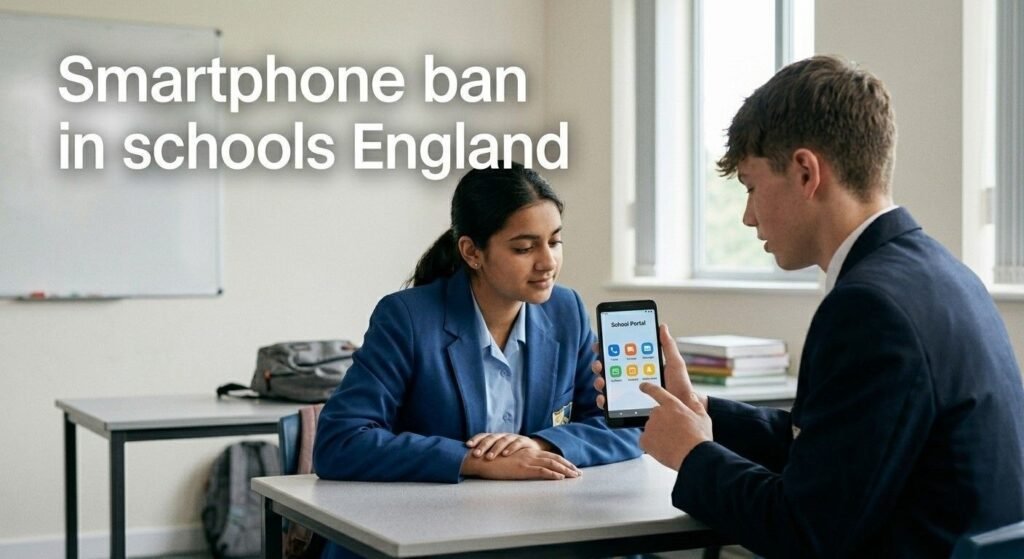
What’s changing: from guidance to a smartphone ban in schools England
England already has guidance encouraging schools to be phone-free throughout the school day. The shift now is legal weight. By making the guidance statutory, ministers would give headteachers and school leaders a clearer legal basis to enforce restrictions, especially when challenged by parents or students.
In plain terms, a smartphone ban in schools England under a statutory framework means:
- schools will be expected to implement phone-free policies as standard
- enforcement becomes easier to defend when disputes arise
- inspection and compliance measures can be tied more directly to policy
This is not necessarily the same as a sweeping “police-style” ban where every device is confiscated. The details of how the guidance is written—and which enforcement models are permitted—will determine how strict it becomes in real classrooms.
Why the government is doing this now
Ministers have previously argued a legal requirement wasn’t needed because most schools already restrict phones. So why shift position?
Based on parliamentary reporting, the government is framing this as a pragmatic move to ensure a broader child welfare bill passes, after the legislation faced resistance and delays. In other words, the phone policy becomes both a safeguarding tool and a political release valve.
This matters because the smartphone ban in schools England is being introduced inside a much larger package of child protection measures, including:
- improved tracking and welfare support for children not in school
- tighter oversight of children’s social care
- administrative changes designed to reduce safeguarding gaps between agencies
So while the phone policy is grabbing headlines, it is also being used as a lever to move a larger bill forward.
Do schools already ban phones? Mostly yes — but enforcement is messy
One of the most cited points in this debate is that schools already do a lot of this. Research referenced in UK coverage suggests nearly all primary schools and a large majority of secondary schools have policies limiting or restricting phone use.
So why bother with law?
Because the hard part is not writing a policy. The hard part is handling the daily friction:
- parents insisting phones are necessary for safety or pickup coordination
- students pushing boundaries, hiding devices, or using smartwatches
- teachers losing time policing a rule inconsistently applied across classes
- disputes over confiscation, damage liability, and exceptions
A statutory smartphone ban in schools England could reduce argument over “whether” a school can enforce a policy—while leaving the “how” to school leaders.
How phone-free schools actually work: the three main models
If England tightens enforcement, most schools will likely fall into one of these models:
1) “Off and away” (bag policy)
Students keep phones but must keep them switched off and stored away. This is the least expensive approach, but also the easiest to violate quietly.
2) Lockers or secure storage
Phones are stored in lockers or a supervised area during the day. This is more effective, but it requires infrastructure, space, and staffing.
3) Sealed pouches (magnet locks)
Students keep phones in locked pouches they can’t open until the end of the day. This is popular because it reduces theft risk and enforcement time, but it costs money and requires consistent procedures.
The policy debate is increasingly about funding: if the government wants a real smartphone ban in schools England, schools argue they need resources for secure storage solutions—not just a legal instruction.
What happens next: inspections, funding questions, and devolved UK rules
Even if England moves forward, education is devolved across the UK. Scotland, Wales, and Northern Ireland can follow different approaches. That means “UK-wide” headlines can be misleading.
England’s direction could also influence how inspections work. If compliance becomes part of how schools are evaluated, it raises the stakes for headteachers—especially if enforcement models remain underfunded.
Key open questions include:
- Will the statutory guidance require a full-day phone-free rule?
- Will schools have discretion for age groups or special needs?
- Will there be funding for lockers/pouches?
- How will rules handle smartwatches and LTE wearables?
- What will enforcement look like during emergencies or lockdowns?
Until those are clarified, the smartphone ban in schools England is best understood as a legal strengthening of an existing trend—not necessarily a brand-new classroom reality.
Why this story is going global: could other countries follow?
Phone bans in schools are politically explosive because they sit at the intersection of:
- child safety
- parental control
- education outcomes
- mental health debates
- technology industry accountability
England making guidance statutory creates a template. If it works—measured by improved behavior, fewer incidents, less classroom disruption—other governments may copy the approach. If it becomes a logistical nightmare or simply shifts phone use to smartwatches, critics elsewhere will point to it as a warning.
Either way, the smartphone ban in schools England debate reflects a broader truth: smartphones are no longer treated as neutral tools in youth education. They’re increasingly viewed as a regulated environment that schools must manage, not ignore.
Bottom line
A smartphone ban in schools England is moving closer to becoming law in practice, by turning existing guidance into a statutory requirement. Supporters see it as essential for safeguarding and classroom focus. School leaders largely agree with the objective, but many argue the real issue is implementation—secure storage, consistent enforcement, and support resources.
If the final rules are clear and schools are supported with practical funding, this could standardize what many schools already try to do. If not, it risks becoming a legal headline that leaves teachers with the same daily battle, just with more paperwork attached. Either way, the world is watching—because what England does next could shape how other countries handle phones in classrooms.