
Gorilla Glass Victus vs Victus 2 is a comparison that matters every time you choose a new smartphone. The cover glass on your phone determines how well the screen survives drops, resists scratches, and holds up to the rough surfaces it encounters every day. Choosing a phone without knowing which glass version it uses is like buying a car without knowing what the bodywork is made from.
This guide explains exactly what separates Gorilla Glass Victus from Victus 2, how each version performs in real-world conditions, which phones use each generation, and whether the difference between them is significant enough to influence your next purchase decision.

What Is Gorilla Glass?
Gorilla Glass is a chemically strengthened cover glass manufactured by Corning, an American materials science company.
It sits on the front surface of your smartphone — the layer your fingers touch every time you use the screen. Its job is to protect the display panel beneath from scratches, drops, and everyday surface contact without adding significant thickness or weight to the device.
Corning strengthens the glass through a chemical ion exchange process. The glass is submerged in a molten potassium salt bath at high temperature. Smaller sodium ions in the glass surface are replaced by larger potassium ions, creating a compressive stress layer that makes the surface significantly harder and more resistant to damage than ordinary glass.
Each new generation of Gorilla Glass improves on this process — either making the compressive layer deeper, adjusting the chemical composition, or refining the manufacturing process to produce glass that handles specific types of damage better than the previous version.
What Is Gorilla Glass Victus?
Gorilla Glass Victus was introduced as a significant step forward from Gorilla Glass 6.
Corning designed Victus with a dual focus — improving both scratch resistance and drop performance simultaneously. Previous generations often required compromises between the two. Making glass harder for scratch resistance sometimes made it more brittle and therefore more likely to crack on impact.
Victus addressed this by refining the chemical strengthening formula to deliver meaningful improvements in both areas without sacrificing one for the other.
Victus Performance Claims From Corning
Corning’s testing for Gorilla Glass Victus showed:
- Survival from drops onto hard, rough surfaces from up to two metres
- Four times better scratch resistance compared to Gorilla Glass 6
- Improved performance on the key drop surfaces that cause most real-world screen breakage
These figures come from Corning’s controlled laboratory testing conditions. Real-world results vary depending on drop angle, surface texture, and the specific device construction.
Which Phones Use Gorilla Glass Victus
Gorilla Glass Victus appeared on a wide range of flagship Android devices including:
| Device | Glass Version |
|---|---|
| Samsung Galaxy S21 Series | Gorilla Glass Victus |
| Samsung Galaxy S22 Series | Gorilla Glass Victus Plus |
| Google Pixel 6 Series | Gorilla Glass Victus |
| OnePlus 9 Series | Gorilla Glass Victus |
| Sony Xperia 1 III | Gorilla Glass Victus |
Gorilla Glass Victus represented the premium standard for smartphone cover glass when it launched and remained the flagship-tier choice across multiple device generations.
What Is Gorilla Glass Victus 2?
Gorilla Glass Victus 2 is the direct successor to Victus, developed specifically to address a weakness that Corning identified in real-world usage data.
While Gorilla Glass Victus performed well in drop tests onto smooth hard surfaces, Corning’s research showed that most real-world phone drops happen onto rougher surfaces — concrete pavements, asphalt, gravel, and textured flooring. These rough surfaces concentrate impact force into smaller contact points, which creates more localized stress on the glass and increases the likelihood of cracking.
Gorilla Glass Victus 2 was engineered specifically to perform better on these rough surface drop scenarios.
Victus 2 Performance Claims From Corning
Corning’s testing for Gorilla Glass Victus 2 showed:
- Improved survival rates from drops onto rough concrete surfaces at one metre
- Maintained scratch resistance comparable to Gorilla Glass Victus
- Better performance on the specific drop surfaces that cause the majority of real-world screen damage
The key distinction in the Gorilla Glass Victus vs Victus 2 comparison is that Victus 2 prioritized rough surface drop survival — the scenario most likely to break a phone in everyday life.
Which Phones Use Gorilla Glass Victus 2
Gorilla Glass Victus 2 appeared on flagship devices from leading Android manufacturers including:
| Device | Glass Version |
|---|---|
| Samsung Galaxy S23 Series | Gorilla Glass Victus 2 |
| Samsung Galaxy S24 Series | Gorilla Glass Victus 2 |
| Google Pixel 8 Series | Gorilla Glass Victus 2 |
| OnePlus 12 | Gorilla Glass Victus 2 |
| Motorola Edge 40 Pro | Gorilla Glass Victus 2 |
Gorilla Glass Victus vs Victus 2 — Direct Comparison
Here is a clear side-by-side comparison of both versions across the factors that matter most in everyday use.
| Feature | Gorilla Glass Victus | Gorilla Glass Victus 2 |
|---|---|---|
| Scratch resistance | Excellent | Excellent (comparable) |
| Smooth surface drop survival | Very good | Very good |
| Rough surface drop survival | Good | Better |
| Real-world drop improvement | Strong baseline | Improved over Victus |
| Thickness | Standard | Comparable |
| Flagship device availability | Wide | Wide |
| Curved screen compatibility | Yes | Yes |
| Primary improvement focus | Dual scratch and drop | Rough surface drop performance |
Gorilla Glass Victus vs Victus 2 — Scratch Resistance
In the Gorilla Glass Victus vs Victus 2 scratch resistance comparison, both versions perform at a similar level.
Corning did not significantly change the scratch resistance formula between the two generations. The focus of Victus 2 was improving drop performance on rough surfaces rather than advancing scratch resistance beyond what Victus already achieved.
Both Victus and Victus 2 resist scratching from everyday materials including coins, keys, and most metal objects. Sand and dust remain the most common real-world scratch sources for both versions, as quartz particles in sand are hard enough to mark the glass surface over time.
If scratch resistance is your primary concern, Gorilla Glass Victus and Victus 2 are effectively equivalent. A screen protector adds meaningful scratch protection on top of either version.
Gorilla Glass Victus vs Victus 2 — Drop Performance
Drop performance is where the Gorilla Glass Victus vs Victus 2 comparison produces a clear winner.
Smooth Surface Drops
On smooth hard surfaces like tiles, hardwood floors, and polished stone, both versions perform similarly. The flat, even surface distributes impact force across a larger contact area, which both Victus and Victus 2 handle well.
Rough Surface Drops
On rough surfaces like concrete pavements, asphalt roads, and textured stone — which represent the majority of real-world drop scenarios — Gorilla Glass Victus 2 performs measurably better than the original Victus.
Rough surfaces create multiple small, sharp contact points rather than one distributed impact zone. Each of those contact points concentrates stress into a tiny area of the glass. Victus 2’s refined composition handles this concentrated stress distribution more effectively than Victus.
This improvement is practically significant. Most phone drops happen outdoors — on pavements, car park surfaces, and rough outdoor flooring. Victus 2’s advantage in these scenarios is exactly where it matters most in everyday life.
Corner and Edge Drops
Both Gorilla Glass Victus and Victus 2 are more vulnerable at corners and edges than across the flat surface.
Corner drops concentrate impact force at a single point with less surface area to distribute the stress. This is true regardless of which Gorilla Glass generation is used. A case with reinforced corners reduces this vulnerability significantly for both versions.
Does the Difference Between Victus and Victus 2 Matter in Real Life?
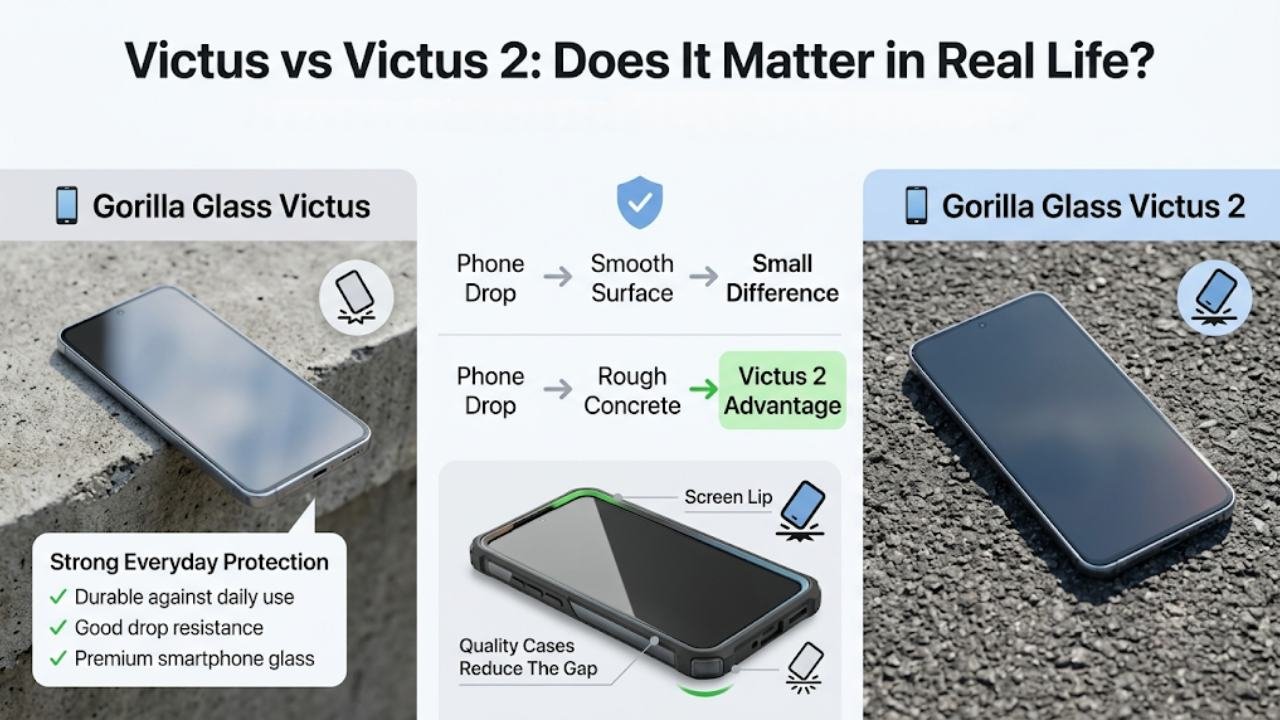
This is the most important practical question in the Gorilla Glass Victus vs Victus 2 discussion.
For most users, the difference is real but modest. Victus 2 genuinely handles rough surface drops better, and rough surfaces are where most real-world damage occurs. If you regularly use your phone outdoors, work in environments with rough flooring, or frequently drop your phone, the improvement in Victus 2 is meaningful.
For users who keep their phone in a protective case most of the time, the difference between Gorilla Glass Victus and Victus 2 is largely neutralized. A quality case with raised screen edges and reinforced corners provides protection that makes the cover glass generation a secondary factor.
The Gorilla Glass Victus vs Victus 2 comparison is most relevant when choosing between devices where one factor in the decision is unprotected or minimally protected use.
Do You Still Need a Screen Protector With Gorilla Glass Victus or Victus 2?
Yes. Both Gorilla Glass Victus and Victus 2 benefit from an additional screen protector layer.
Cover glass — regardless of generation — handles everyday drops and moderate scratches well. But it is not immune to damage. Sharp objects, sand particles, and high-energy drops onto rough surfaces can still cause visible damage to both Victus and Victus 2 surfaces.
A tempered glass screen protector adds a sacrificial layer on top of the cover glass. If the protector cracks, it absorbs the impact that might otherwise have damaged the cover glass. Replacing a screen protector costs a fraction of what a cracked cover glass repair costs.
Recommended Screen Protector Types
For flat displays using either Gorilla Glass version:
- Tempered glass protectors — Best scratch and impact protection, natural feel
For curved displays using either Gorilla Glass version:
- Hydrogel protectors — Best coverage on curved edges, flexible and conforming
- UV-bonded curved tempered glass — Full glass feel with proper edge coverage
Common Mistakes When Evaluating Gorilla Glass Victus vs Victus 2
Assuming Gorilla Glass Makes a Phone Unbreakable
Neither Victus nor Victus 2 makes a screen unbreakable. Both versions significantly improve survival rates compared to older glass generations, but no cover glass eliminates the risk of cracking under sufficient impact.
Ignoring the Role of Device Construction
How the glass is mounted and supported within the phone chassis affects drop performance as much as the glass itself. A phone with a well-engineered frame that absorbs and distributes impact can outperform a phone with better glass but a less rigid construction.
Overlooking the Cover Glass on the Back
Many smartphones also use Gorilla Glass on the rear panel. The Gorilla Glass Victus vs Victus 2 comparison applies to back glass protection as well as the front display. Check which version covers both surfaces when evaluating a device.
Choosing a Phone Based Solely on Glass Version
Glass generation is one factor among many. Camera quality, processing performance, software support, and battery life all influence the overall experience. Gorilla Glass Victus vs Victus 2 should be one data point in a broader purchase decision, not the defining factor.
FAQs
Is Gorilla Glass Victus 2 significantly better than Victus?
Gorilla Glass Victus 2 improves specifically on rough surface drop performance compared to the original Victus. Scratch resistance is comparable between both versions. The improvement is real and practically relevant but modest rather than transformative.
Which phones use Gorilla Glass Victus 2?
Samsung Galaxy S23 and S24 series, Google Pixel 8 series, OnePlus 12, and several other flagship Android devices use Gorilla Glass Victus 2 as their front cover glass.
Do I still need a screen protector with Gorilla Glass Victus 2?
Yes. Gorilla Glass Victus 2 provides strong protection but is not indestructible. A tempered glass or hydrogel screen protector adds a sacrificial protective layer that significantly reduces the risk of cover glass damage from drops and scratches.
Is Gorilla Glass Victus or Victus 2 scratch proof?
Neither version is scratch proof. Both resist scratching from most everyday materials including coins and keys. Sand particles, sharp metal tools, and abrasive surfaces can still leave visible marks on both Victus and Victus 2 surfaces.
Does a case eliminate the advantage of Gorilla Glass Victus 2 over Victus?
A good protective case with raised edges and reinforced corners significantly reduces the practical difference between the two versions. Both perform well with proper case protection. The Victus 2 advantage is most relevant in unprotected or minimally protected use scenarios.
Final Thoughts
The Gorilla Glass Victus vs Victus 2 comparison comes down to one key difference — Victus 2 handles rough surface drops more effectively than the original Victus. Both versions offer excellent scratch resistance at a similar level, and both represent the current standard for flagship smartphone cover glass.
If you are choosing between two phones where one uses Victus and the other uses Victus 2, Victus 2 offers a genuine improvement for real-world drop scenarios. The difference is meaningful but not dramatic enough to make Victus feel inadequate — both are strong cover glass options by any reasonable standard.
What matters most alongside the glass generation is how you use and protect your phone. A device with Gorilla Glass Victus in a quality case with a screen protector will outlast an unprotected phone with Victus 2 in most real-world situations.
Use the Gorilla Glass Victus vs Victus 2 comparison as one informed data point in your device choice, protect whichever glass you end up with, and your screen will serve you well for the long term.