
AMOLED Glass vs LCD Glass durability is one of the most practical questions any smartphone buyer should ask before purchasing a new device. Your screen is the part of your phone most exposed to daily wear, accidental drops, and surface contact. Understanding how each display type holds up in real conditions directly affects how you protect your phone and how much repair costs you might face.
This guide explains the structural differences between AMOLED and LCD displays, compares how each type handles scratches and drops, clarifies what the cover glass does in each case, and gives you clear guidance on which needs more protection and why.

What Makes AMOLED and LCD Screens Structurally Different
Before comparing durability, it is important to understand that AMOLED glass vs LCD glass is not just a comparison of two types of glass. It is a comparison of two fundamentally different screen constructions — and those differences affect how each type breaks, scratches, and survives daily use.
How AMOLED Screens Are Built
An AMOLED screen consists of several thin layers bonded together:
- The cover glass on top
- A touch sensing layer beneath the glass
- The OLED panel itself, which produces its own light
- A flexible or rigid backing substrate
Because each pixel in an AMOLED panel generates its own light, there is no need for a separate backlight layer. This makes AMOLED displays thinner overall. The panel is also often bonded directly to the glass using an optical adhesive, which reduces the gap between layers and improves both clarity and structural cohesion.
How LCD Screens Are Built
An LCD screen has a different internal structure:
- The cover glass on top
- A touch sensing layer
- A liquid crystal layer that controls light transmission
- A color filter layer
- A backlight layer at the bottom
LCD panels are typically thicker than AMOLED panels because of the backlight assembly. The additional layers also mean there is more internal structure that can delaminate or separate if the screen suffers a significant impact.
Why Structure Affects Durability
In the AMOLED glass vs LCD glass comparison, structure matters because it determines how force distributes through the screen when dropped or impacted.
AMOLED panels — particularly those using flexible OLED technology — can absorb and distribute impact differently from rigid LCD panels. However, this also means AMOLED displays can crack in ways that spread across the panel rapidly, while LCD damage sometimes stays more localized depending on the impact point.
AMOLED Glass vs LCD Glass — Scratch Resistance
Scratch resistance in the AMOLED glass vs LCD glass comparison depends primarily on the cover glass used, not the display panel beneath it.
Both AMOLED and LCD screens use the same types of cover glass — Gorilla Glass, Dragon Tail, or similar materials. The display panel technology beneath the glass does not directly affect how resistant the screen surface is to scratches.
What Actually Determines Scratch Resistance
The cover glass generation is what matters for scratch protection:
| Cover Glass Type | Scratch Resistance | Common Usage |
|---|---|---|
| Gorilla Glass 5 | Good | Midrange devices |
| Gorilla Glass 6 | Better | Upper midrange |
| Gorilla Glass Victus | Very good | Flagship AMOLED devices |
| Gorilla Glass Victus 2 | Excellent | Latest flagship devices |
| Dragon Tail Glass | Moderate | Budget to midrange |
A flagship AMOLED device with Gorilla Glass Victus will resist scratches significantly better than a budget LCD device with basic Dragon Tail glass. However, a midrange LCD phone with Gorilla Glass 6 may scratch at a similar rate to a similarly specced AMOLED device.
The takeaway from the AMOLED glass vs LCD glass scratch comparison is this — the cover glass generation matters more than the display technology beneath it.
What Scratches Smartphone Glass in Real Life
Most users are surprised to learn that ordinary sand and dust particles can scratch smartphone glass. Sand contains quartz, which sits at level 7 on the Mohs hardness scale. Even Gorilla Glass Victus rates around 6 to 7 on the same scale.
This means placing your phone face-down on a sandy or gritty surface — even briefly — can leave micro-scratches on the cover glass regardless of whether the display is AMOLED or LCD.
Keys, metal tools, and rough concrete are also common scratch sources in everyday use.
AMOLED Glass vs LCD Glass — Drop Resistance and Break Patterns
Drop resistance is where the AMOLED glass vs LCD glass comparison becomes more nuanced and practically important.
How AMOLED Screens Break
AMOLED panels — especially those using flexible OLED substrates — tend to crack in spreading patterns when dropped.
A significant impact can cause the OLED panel itself to crack beneath the cover glass, even when the cover glass appears intact or shows only minor surface damage. This is sometimes called internal screen damage — the cover glass survives but the display panel beneath is damaged, resulting in black spots, color bleed, or partial screen failure.
Flexible AMOLED panels used in curved-edge phones are particularly susceptible to edge impacts. The curved portion of the screen is structurally thinner at the edges and transfers impact force differently compared to a flat display.
How LCD Screens Break
LCD panels generally crack differently from AMOLED panels.
The backlight assembly in an LCD provides additional structural support behind the panel. When an LCD screen breaks, the damage often appears as a spiderweb crack pattern radiating from the impact point. The display may continue to function partially even with visible cracking, though backlight bleeding typically appears around damaged areas.
LCD screens are less likely to suffer invisible internal damage from drops. The damage is usually visible on the surface and corresponds directly to where the impact occurred.
Repair Cost Implications
This difference in break patterns has a direct effect on repair costs — an important practical consideration in the AMOLED glass vs LCD glass comparison.
| Repair Factor | AMOLED Screen | LCD Screen |
|---|---|---|
| Average repair complexity | Higher | Lower |
| Internal damage risk | Higher | Lower |
| Panel replacement cost | Generally higher | Generally lower |
| Partial function after damage | Less common | More common |
| Cover glass only repair | Rarely sufficient | Sometimes possible |
AMOLED screen repairs typically require full panel replacement because the OLED layer and the glass are bonded together in most modern constructions. LCD repairs sometimes allow for cover glass replacement only if the panel beneath remains undamaged.
How Curved Screens Affect the AMOLED Glass vs LCD Glass Durability Comparison
Curved screens add another layer of complexity to the AMOLED glass vs LCD glass durability discussion.
The vast majority of curved-edge smartphones use AMOLED panels. Flexible OLED technology makes curved displays possible. LCD panels are almost always flat because the backlight assembly does not bend.
Why Curved AMOLED Screens Are More Vulnerable at Edges
The curved edges of AMOLED displays are structurally thinner than the flat center of the screen. When a phone with curved edges lands on a corner or edge, the force concentrates on the thinnest and most vulnerable part of the display.
This is why curved AMOLED screens crack at the edges more frequently than flat screens crack across their surface. The design creates a visual and functional advantage — immersive edge-to-edge display — but introduces a structural vulnerability at those same edges.
Flat AMOLED displays and flat LCD displays do not share this specific vulnerability, which makes flat screen designs more durable in corner drop scenarios regardless of display technology.
Screen Protectors for AMOLED vs LCD — What You Actually Need
Understanding the AMOLED glass vs LCD glass durability difference helps inform which screen protector makes the most sense for your specific device.
For Flat AMOLED Screens
Flat AMOLED screens pair well with standard tempered glass screen protectors. The flat surface allows full adhesion without lifting edges, and the 9H hardness rating provides meaningful additional scratch protection on top of the cover glass.
A tempered glass protector on a flat AMOLED device with Gorilla Glass Victus creates a genuinely strong scratch-resistant surface for everyday use.
For Curved AMOLED Screens
Curved AMOLED screens present a more challenging screen protector situation. Standard tempered glass protectors do not conform to curved edges, often leaving raised edges that lift over time.
Hydrogel screen protectors solve this problem. They flex to match the curve of the display, maintain full coverage including the edges, and provide reasonable scratch protection. They offer less impact protection than tempered glass but full coverage on curved surfaces.
UV-bonded tempered glass protectors designed specifically for curved screens are another option, though they require precise installation and are more expensive.
For LCD Screens
LCD screens are almost always flat, which makes standard tempered glass protectors straightforward to apply and effective in use.
Because LCD repair costs are generally lower than AMOLED repair costs, some users choose basic TPU film protectors for LCD devices as a cost-effective option. For devices that see heavy daily use or frequent drops, a tempered glass protector remains the better choice.
Practical Tips for Protecting Both Screen Types
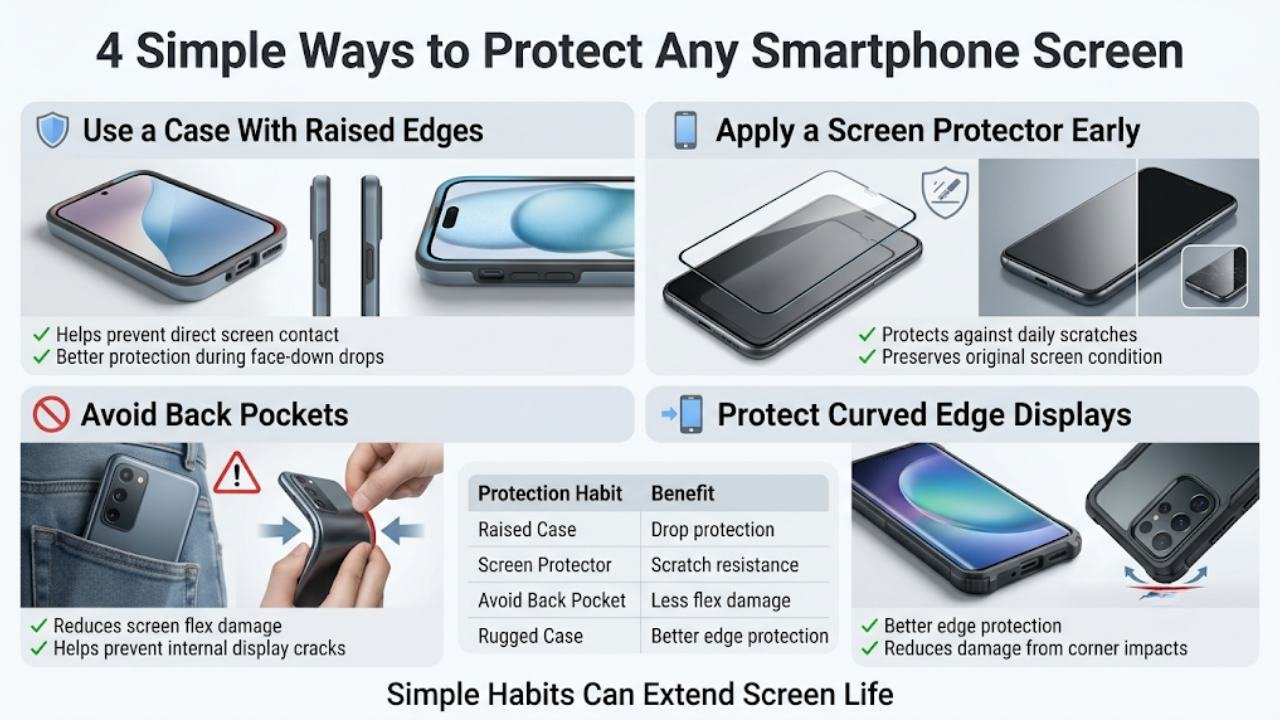
Regardless of where you stand on the AMOLED glass vs LCD glass durability comparison, these protection habits apply to both display types.
Always use a case with raised edges
A case that raises the rim around the screen prevents the glass from making direct contact with surfaces when the phone lies flat or falls face-down. Even a one millimetre lip makes a meaningful difference.
Apply a screen protector from the first day
The cover glass is at its most pristine on day one. Micro-scratches that accumulate over weeks of unprotected use cannot be reversed. Starting with a screen protector preserves the surface under the protector for the life of the device.
Avoid back pockets
Sitting on your phone is one of the most common causes of AMOLED panel damage. The combination of pressure and flex from sitting can crack the OLED panel without necessarily breaking the cover glass visibly.
Handle edge drops carefully on curved AMOLED devices
If you use a phone with curved AMOLED edges, be particularly conscious of corner and edge drops. A rugged case that wraps the curved edges provides meaningfully better protection than a thin case that leaves edges exposed.
FAQs
Is AMOLED glass more durable than LCD glass?
Not necessarily. Both display types use similar cover glass materials. AMOLED panels can suffer internal damage from drops without visible cover glass breakage. LCD panels tend to show damage more visibly but may partially function after damage. Neither is universally more durable — the cover glass generation and case protection matter more.
Why do AMOLED screens cost more to repair than LCD screens?
AMOLED panels bond the display layer and cover glass together using optical adhesive, making separation and cover-glass-only repairs difficult. Full panel replacement is usually required. LCD panels sometimes allow cover glass replacement without replacing the display layer, which reduces repair costs.
Do curved AMOLED screens break more easily than flat LCD screens?
Curved AMOLED screens are more vulnerable at the edges due to the thinner and more flexible construction at the curve. Flat LCD screens distribute impact force more evenly across the surface. For pure durability against edge drops, flat screens have a structural advantage.
Which screen protector works best for curved AMOLED displays?
Hydrogel screen protectors conform to curved surfaces better than rigid tempered glass options. UV-bonded curved tempered glass protectors designed for specific device models also provide good coverage but require careful installation.
Does the display type affect how easily a screen scratches?
No. Scratch resistance depends on the cover glass material and generation, not whether the display panel beneath is AMOLED or LCD. A device with Gorilla Glass Victus will resist scratches better than one with basic Dragon Tail glass regardless of display technology.
Final Thoughts
The AMOLED glass vs LCD glass durability comparison reveals that display technology and screen durability are related but separate topics. The cover glass generation and the physical construction of the screen — flat versus curved, bonded versus layered — have more practical impact on daily durability than whether the panel underneath is AMOLED or LCD.
AMOLED screens offer a superior visual experience and are the clear choice for anyone who values color quality, contrast, and battery efficiency. They do come with a higher repair cost if damaged and require more thoughtful protection — particularly on curved-edge designs.
LCD screens are structurally simpler, generally less expensive to repair, and damage in more predictable and visible ways. They remain a practical choice for budget-conscious buyers who prioritize durability and lower ownership costs.
Whatever display type your phone uses, the single most effective thing you can do for long-term screen health is apply a quality screen protector immediately and use a case with raised edges every day. Those two habits eliminate the vast majority of screen damage that most users experience.