
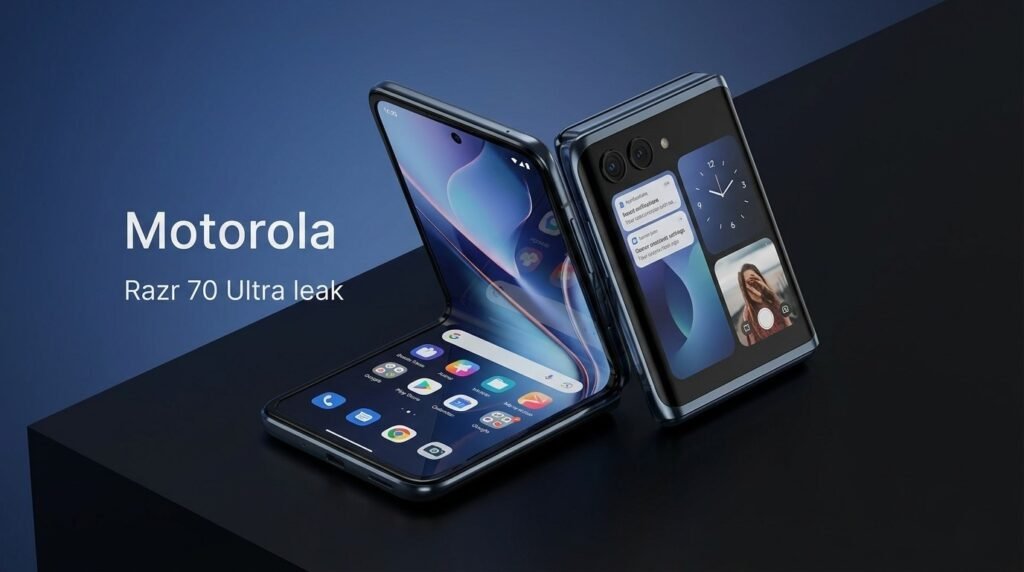
Motorola Razr 70 Ultra leak details are starting to paint a clearer picture of Motorola’s next clamshell foldables, and the big story is less about a radical redesign and more about strategy. Fresh reports suggest Motorola is preparing two models—the Razr 70 and Razr 70 Ultra—with familiar form factors, modest battery changes, and a performance split designed to keep the “Ultra” model premium without completely collapsing the lineup’s price ladder.
For foldable fans, the timing is important. Samsung Galaxy Z Flip continues to define the mainstream clamshell category globally, but Motorola has steadily carved out a niche by delivering larger cover screens, more playful finishes, and a cleaner Android experience than many rivals. If the Motorola Razr 70 Ultra leak is accurate, Motorola plans to keep leaning into that identity while nudging specs forward in the places that matter most for daily use: refresh rate, storage speed, and charging.
Below is what the leaks claim, what the rumored pricing suggests about Motorola’s positioning, and how the Razr 70 Ultra could stack up against the Galaxy Z Flip in the next phase of the foldable battle.
Motorola Razr 70 Ultra leak: expected pricing and where it fits
Let’s start with the buyer question: how much will it cost?
Leaks currently point to pricing around:
- Razr 70: starting at $799.99
- Razr 70 Ultra: starting at $1,099.99
If those figures hold, Motorola is essentially keeping the familiar split: one “accessible” foldable and one more premium model that pushes toward flagship pricing—still generally below the top-end Fold-style devices, but in direct competition with Samsung’s higher-tier Flip variants.
The pricing also suggests something else: Motorola is confident the Ultra can justify its premium even without a headline “new form factor.” That means the improvements will need to show up in performance stability, display experience, and cover-screen usability—areas where Motorola already has fans.
Razr 70 specs: incremental upgrades with a mid-premium chip
The standard Razr 70 is described as a measured update rather than a reinvention. According to the leak, it may include:
- 6.9-inch AMOLED inner display with 120Hz
- MediaTek Dimensity 7450X (up to 2.6GHz)
- LPDDR5X RAM and UFS 3.1 storage
- Dual 50MP rear cameras (main + ultrawide)
- 32MP selfie camera
- Slightly larger 4,800mAh battery
This is a classic “make it better, don’t make it expensive” approach. A bigger battery is welcome—battery has always been a pain point for clamshell foldables—and pairing it with modern RAM/storage standards should keep the phone snappy.
The key compromise is chipset tier. Dimensity 7450X positions the Motorola Razr closer to upper midrange performance rather than flagship speed. For many buyers, that’s fine: most people buying a flip phone are buying the design and portability first, not maximum benchmark numbers. But it does mean Motorola needs good thermal tuning so the phone doesn’t feel sluggish during camera sessions or long social scrolling.
Razr 70 Ultra: what the leak says is changing (and what isn’t)
The Motorola Razr 70 Ultra leak suggests the Ultra remains a 6.9-inch inner-display clamshell, but with key spec upgrades designed to justify the price jump.
Display: 165Hz could be the headline spec
A 165Hz refresh rate on the inner display is unusually high—even among premium phones. If Motorola executes this well, it could improve:
- perceived smoothness in scrolling and animations
- touch responsiveness in supported games
- overall “premium” feel when navigating the UI
However, it raises a practical question: will the phone run at 165Hz often, or will it drop down aggressively to save battery? High refresh is only valuable if it’s well-managed.
Performance: Snapdragon 8s Gen 3 is an interesting choice
Here’s where the leak gets spicy. The Ultra is tipped to run on Snapdragon 8s Gen 3 with LPDDR5X RAM and UFS 4.0 storage.
On paper, 8s Gen 3 is a powerful chip, but it’s not the top-tier Snapdragon flagship part. That choice will generate debate, especially if buyers expected the absolute latest “Elite” level silicon in an Ultra-branded foldable.
Still, there are plausible reasons Motorola might go this route:
- better efficiency and thermals for a compact foldable chassis
- cost control to hit a competitive price point
- product hierarchy positioning if Motorola wants a higher-end foldable above the Ultra
The inclusion of UFS 4.0 is a big deal, though. Faster storage improves:
- app loading speed
- camera processing workflows
- system responsiveness during multitasking
Battery and charging: smaller battery, but reasonable speeds
Leaks suggest:
- 4,500mAh battery
- 45W wired charging
- 15W wireless charging
This is a bit surprising next to the rumored 4,800mAh on the standard model. But battery sizing is complicated in foldables due to internal packaging and weight distribution.
If Motorola can deliver good endurance through optimization, the charging speeds should help offset smaller capacity—especially for users who top up frequently during the day.
Cameras: familiar hardware, likely better tuning
The Ultra is expected to keep a similar dual-camera concept. Even without a telephoto, Motorola can still compete if it improves:
- shutter speed and HDR consistency
- low-light performance
- portrait edge detection and skin tone accuracy
- video stabilization on the main sensor
In foldables, the cover screen is also a camera advantage: you can use the main camera for selfies. That’s where Motorola’s cover display experience often shines.
How the Razr 70 Ultra could compete with Galaxy Z Flip
Samsung wins on brand reach, carrier availability, and ecosystem polish. Motorola tends to win on personality and cover-screen usability.
If the Motorola Razr 70 Ultra leak is accurate, Motorola’s competitive hooks could be:
- higher refresh rate inner display
- fast UFS 4.0 storage
- strong cover-screen experience (Motorola’s traditional advantage)
- standout finishes and materials that feel less generic than “black slab” designs
Where Samsung may still have the edge:
- long-term software update perception and rollout speed
- global distribution and trade-in programs
- accessory ecosystem
For Motorola, the key will be pricing discipline and software reliability. Foldables are already a trust purchase; buyers want reassurance that the hinge, screen protector, and updates will hold up.
Launch timeline: what to watch for next
Motorola hasn’t teased the lineup publicly yet, which usually means we’re still in the leak-heavy phase. If these devices are close, the next confirms typically include:
- regulatory certifications and model numbers
- more renders and case listings
- carrier database listings
- benchmark sightings for the Ultra model
If pricing is really $799.99 and $1,099.99, Motorola will likely push marketing hard around “premium foldable experience without the highest premium price.”
Bottom line
The Motorola Razr 70 Ultra leak suggests Motorola is doubling down on refinement: a smoother display, faster storage, competitive charging, and a performance tier that aims to balance heat and cost in a slim foldable body. It may not be the spec monster some enthusiasts want, but for mainstream foldable buyers—people who want a stylish clamshell with a great cover display and solid daily performance—this looks like a calculated and potentially effective next step.
The big question is whether Motorola can make the Ultra feel truly “Ultra” at $1,099. If it can deliver better real-world camera output, stable performance, and a cover-screen experience that outclasses the competition, the Razr 70 Ultra could be Motorola’s strongest Flip rival yet.