
Google has unveiled a major breakthrough in artificial intelligence with the introduction of Google Gemma 4 on-device AI, a new family of open models designed to run directly on smartphones without relying on cloud infrastructure. This shift represents a fundamental change in how AI is delivered, moving away from server-dependent systems toward faster, more private, and locally processed intelligence.
The launch of Google Gemma 4 on-device AI is not just another incremental update in the AI race; it signals a broader transformation in the Android ecosystem. For years, advanced AI features have depended heavily on internet connectivity and remote servers. With this new approach, powerful AI capabilities can now function entirely on-device, opening up new possibilities for developers and users alike.
A New Era: AI Without the Cloud
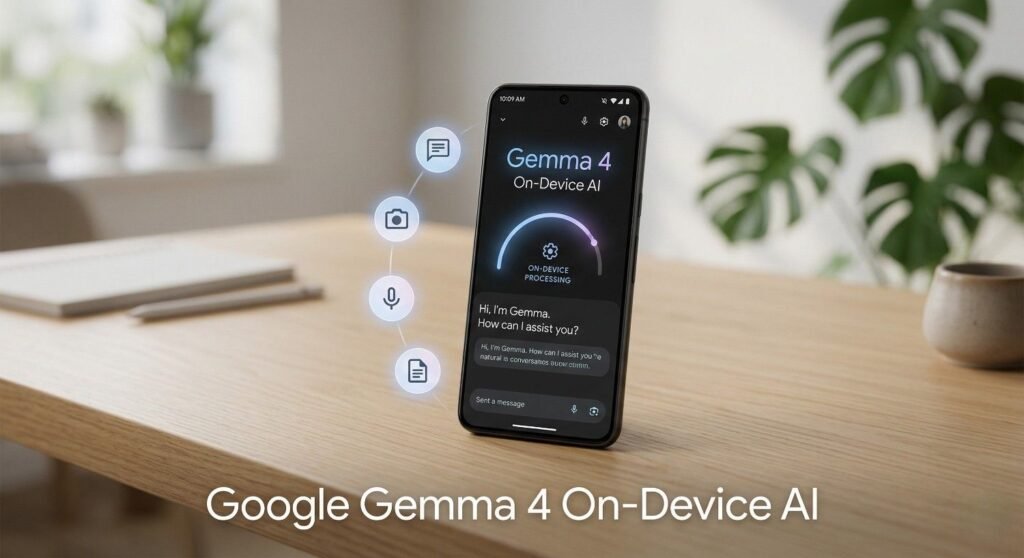
At the core of Google Gemma 4 on-device AI is its ability to operate independently of cloud infrastructure. This means that tasks such as text generation, image understanding, and even complex reasoning can be performed directly on a smartphone.
This approach offers several advantages. First, it significantly reduces latency, allowing responses to be generated almost instantly. Second, it enhances privacy, as user data no longer needs to be sent to external servers for processing. Third, it ensures reliability in offline scenarios, enabling AI functionality even in areas with limited or no internet connectivity.
These benefits position Google Gemma 4 on-device AI as a key enabler of the next generation of mobile computing, where intelligence is embedded directly into devices rather than accessed remotely.
Multiple Models Designed for Different Use Cases
Google Gemma 4 on-device AI is not a single model but a family of models tailored for various performance and efficiency requirements. Smaller variants are optimized for mobile devices, making them suitable for smartphones and edge computing applications.
Larger models within the family are designed for more demanding tasks, offering advanced reasoning capabilities and higher accuracy. Despite their increased complexity, these models are engineered to maintain efficiency, ensuring that they can still be deployed in practical scenarios.
This modular approach allows developers to choose the most appropriate model for their specific needs, balancing performance and resource consumption.
Open-Source Strategy Expands Developer Access
A defining feature of Google Gemma 4 on-device AI is its open nature. Unlike many proprietary AI systems, these models are available for developers to download, modify, and deploy freely.
This open approach is expected to accelerate innovation, as developers can experiment with new use cases and integrate AI capabilities into a wide range of applications. It also lowers the barrier to entry, enabling smaller teams and independent developers to build advanced AI-powered solutions.
By embracing openness, Google is fostering a more collaborative ecosystem, where innovation is driven by the community rather than controlled by a single entity.
Advanced Capabilities Beyond Basic AI
Google Gemma 4 on-device AI introduces a range of advanced features that go beyond traditional AI applications. The models are capable of multi-step reasoning, enabling them to solve complex problems and perform tasks that require logical thinking.
They also support multimodal inputs, allowing them to process text, images, and even audio in certain configurations. This versatility makes them suitable for a wide range of applications, from content creation to productivity tools.
Another notable capability is support for long context windows, which enables the models to analyze large amounts of information in a single interaction. This is particularly useful for tasks such as document analysis and code generation.
Integration With the Android Ecosystem
The introduction of Google Gemma 4 on-device AI is closely tied to the future of Android. These models are expected to serve as the foundation for upcoming on-device AI features, including enhancements to existing systems like Gemini Nano.
For Android users, this could translate into smarter assistants, more responsive applications, and new capabilities that were previously not possible without cloud support. The integration of on-device AI also aligns with broader industry trends toward edge computing and decentralized processing.
As Android devices become more powerful, the ability to run advanced AI models locally will become an increasingly important differentiator.
Privacy and Performance Benefits
One of the most compelling aspects of Google Gemma 4 on-device AI is its focus on privacy. By keeping data on the device, users can have greater confidence that their information is not being transmitted or stored externally.
Performance is another key advantage. Local processing eliminates the delays associated with network communication, resulting in faster response times. This is particularly important for real-time applications, where even small delays can impact the user experience.
Together, these benefits make on-device AI a compelling alternative to traditional cloud-based approaches.
Implications for the AI Industry
The launch of Google Gemma 4 on-device AI has broader implications for the AI industry as a whole. It challenges the dominance of cloud-based models and introduces a new paradigm where intelligence is distributed across devices.
This shift could lead to increased competition, as other companies explore similar approaches to on-device AI. It may also influence how AI services are monetized, as the reliance on cloud infrastructure decreases.
For developers and businesses, the availability of powerful on-device models opens up new opportunities to create innovative products and services.
What This Means for Users
For everyday users, Google Gemma 4 on-device AI represents a significant step forward in convenience and functionality. The ability to access advanced AI features without an internet connection can enhance productivity, creativity, and overall user experience.
Whether it is generating content, analyzing data, or interacting with smart assistants, users can expect faster and more reliable performance. The added privacy benefits further strengthen the appeal of this approach.
As these capabilities become more widely adopted, they could fundamentally change how users interact with their devices.
Final Thoughts
Google Gemma 4 on-device AI is more than just a technological advancement; it is a glimpse into the future of mobile computing. By bringing powerful AI capabilities directly to smartphones, Google is redefining the role of devices in the digital ecosystem.
The combination of speed, privacy, and flexibility makes this approach highly compelling, particularly for Android users. As the technology continues to evolve, it is likely to play a central role in shaping the next generation of intelligent devices.