
Google Aluminium OS Leak Signals Android’s Unified Future
A fresh Google Aluminium OS leak has given us our clearest look yet at what could become Google’s most ambitious platform shift in years. Screenshots and short video clips, reportedly pulled from an internal Google bug report before being removed, reveal a new operating system that blends the strengths of Android and ChromeOS into a single, cross-platform experience. If the early signs are accurate, Aluminium OS could reshape how Google thinks about phones, tablets, laptops, and even wearables.
The leak has already sparked massive discussion across the Android community, and for good reason. Google Aluminium OS isn’t just another Android fork or ChromeOS update—it appears to be a long-term strategy aimed at unifying Google’s fragmented software ecosystem.
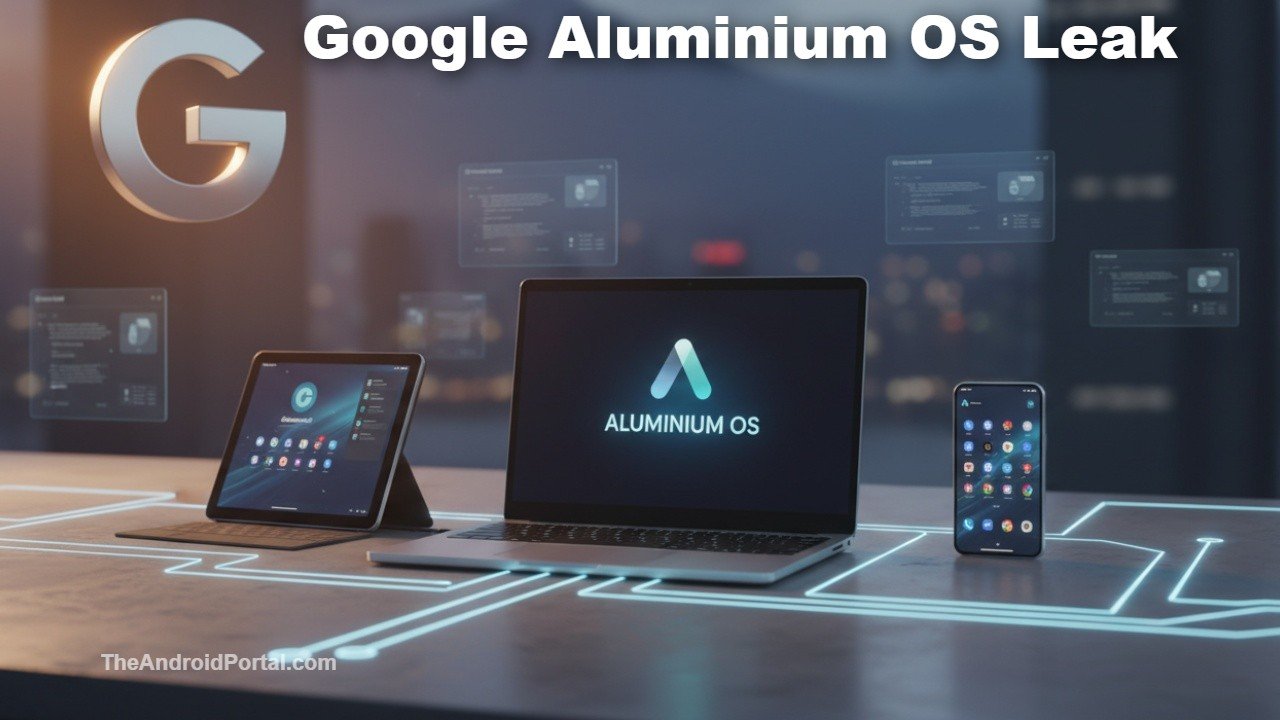
What Is Google Aluminium OS and Why It Matters
At its core, Google Aluminium OS is designed as a successor to ChromeOS while deeply integrating modern Android capabilities. According to the leaked material, the OS borrows heavily from Android 16’s desktop-style features while retaining ChromeOS’ productivity-first DNA.
Unlike ChromeOS, which primarily targets Chromebooks, Aluminium OS is reportedly being built with broader device compatibility in mind. Early references point to support for:
- Laptops and Chromebooks
- Android tablets
- Future hybrid devices
- Potential expansion to smartwatches and foldables
This approach suggests Google is finally serious about delivering a unified operating system that scales seamlessly across screen sizes—something it has struggled to perfect for over a decade.
Desktop-Style Interface With Android at Its Core
One of the most striking elements in the leak is the interface. Google Aluminium OS features a desktop-style layout with a persistent taskbar and launcher that closely resembles Android’s emerging desktop mode. Split-screen multitasking is front and center, reinforcing the OS’s focus on productivity.
The leaked footage, captured on an HP Elite Dragonfly Chromebook, shows multiple apps running side by side with fluid window management. Android apps appear to run natively, complete with access to the Google Play Store, reinforcing the idea that Android is the foundation—not an afterthought.
Key UI highlights seen in the leak:
- Desktop-style taskbar inspired by Android 16
- Multi-window and split-screen support
- Native Google Play Store integration
- Familiar Android system icons and status bar
For users, this could finally mean a consistent experience across Android phones, tablets, and larger form-factor devices.
Seamless Updates and Gemini@ AI Integration
Another major highlight of the Google Aluminium OS leak is how it handles updates. In the demo, apps—specifically Google Chrome—update in the background without closing or restarting. This is a notable improvement over ChromeOS, where updates can still interrupt workflows.
Equally important is the deep integration of Gemini AI. Gemini appears prominently among pre-installed apps, signaling that AI will be a core pillar of Aluminium OS rather than a bolt-on feature. This aligns with Google’s broader push to embed Gemini across Android updates, Pixel devices, and productivity tools.
Expect AI-powered features like contextual assistance, smarter multitasking, and system-level automation to play a major role as Aluminium OS evolves.
Is Aluminium OS Replacing ChromeOS?
While Google has not officially confirmed anything, the leak strongly suggests that Google Aluminium OS is intended to replace ChromeOS over time. However, this won’t be an overnight transition.
Google is expected to continue supporting ChromeOS for several years, especially for education and enterprise customers. Aluminium OS appears positioned as a long-term replacement that gradually absorbs ChromeOS’ user base once it matures.
This mirrors Google’s past transitions, where parallel platforms coexist before one eventually becomes dominant.
What This Means for Android’s Future
For Android users, Google Aluminium OS leak could finally solve long-standing issues around large-screen optimization and app consistency. A unified OS could also simplify updates, reduce fragmentation, and encourage developers to build experiences that scale naturally across devices.
It also opens the door for tighter integration between Android phones, Pixel tablets, Chromebooks, and future Samsung and Google hardware—something Apple has long mastered with its ecosystem.
Release Timeline: What We Know So Far
As of now, there is no confirmed release date for Google Aluminium OS. The leak suggests it’s still in active development, and public previews are likely months—if not years—away. That said, the existence of working builds indicates Google is further along than many expected.