
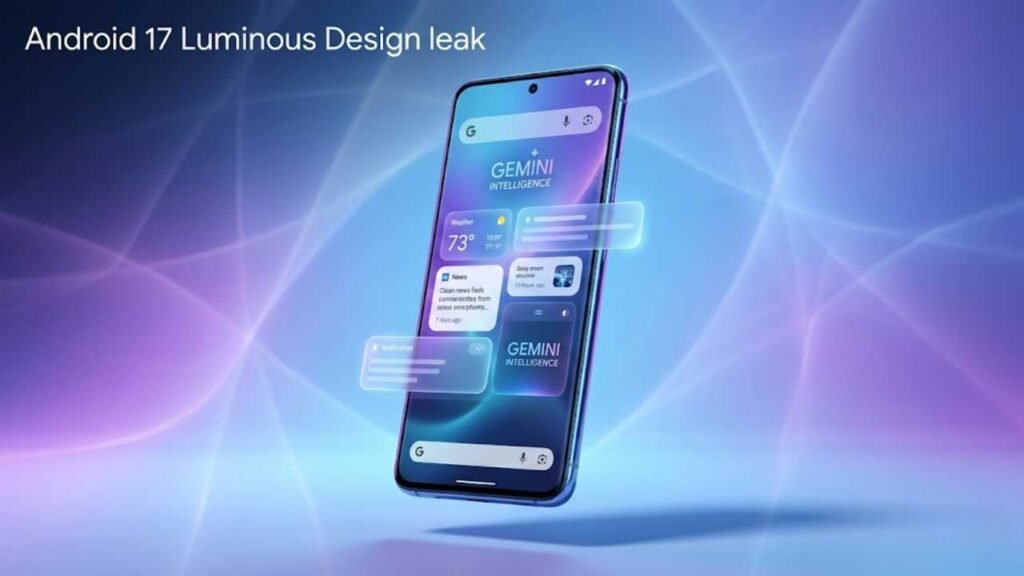
Android 17 Luminous Design leak is the kind of rumor that explodes in Google Discover for a reason: it combines two things people love arguing about—UI design and AI branding—plus a whiff of Apple comparison. A newly surfaced report points to a confidential Pixel video that appears to show a new “Gemini Intelligence” identity running on an unreleased build, alongside talk of a UI direction called “Luminous Design,” which some observers are already framing as Google’s answer to Apple glossy, transparency-heavy interface trends.
None of this is confirmed by Google yet. But the timing makes the leak more believable than the average fan mockup. Google is weeks away from its Android-focused pre‑I/O event, and it has already been teasing that this will be a major year for Android. When a leak name-drops both a new design language and a new AI umbrella term, it usually means internal teams are preparing a broader narrative—not just a small visual tweak.
So what is the Android 17 Luminous Design leak actually suggesting? That Android 17 could ship with a more modern, “depth” focused aesthetic built around blur, transparency, and polished animations—while Pixel’s AI story may get a brand lift from “Gemini” to “Gemini Intelligence.”
Here’s what we know, what’s speculation, and why the “Luminous vs Liquid Glass” debate misses the point.
What the leak claims: “Gemini Intelligence” + “Luminous Design”
The Android 17 Luminous Design leak centers on two reported elements:
- Gemini Intelligence — a potential new branding layer that frames Gemini less as a standalone assistant and more as a system-wide intelligence suite.
- Luminous Design — a design direction associated with transparency, blur, and glass-like UI layers that change how Android surfaces depth and hierarchy.
If true, this is less about one app update and more about a platform messaging shift. Google has spent the last year pushing “Gemini” as the AI name users should learn. Adding “Intelligence” is a signal that Google wants to treat AI as a native platform capability, not an optional feature.
Meanwhile, “Luminous Design” sounds like a label for a UI refresh that could span:
- Android system UI
- Pixel launcher surfaces
- first‑party Google apps
- transitions and animation polish
The “leaked video” element is also important. Video leaks tend to be harder to fake convincingly than still images, especially when they include subtle motion design and system elements.
Android 17 Luminous Design leak vs “Liquid Glass”: why comparisons are inevitable
Whenever Apple is rumored to be polishing its own UI style, Android leaks get compared to it. In this case, some people are already positioning the Android 17 Luminous Design leak as Google’s counterpart to Apple’s “Liquid Glass” aesthetic rumors—meaning more translucent panels, layered blur, and glossy UI components.
But the more useful question is not “who copied who.” It’s whether Android needs a sharper visual identity as AI becomes more central.
Android today is powerful, but it can feel inconsistent across devices, skins, and apps. A more coherent design system—especially one that looks modern and handles depth well—could help Google deliver a UI that feels intentional rather than piecemeal.
If Android 17 truly leans into “Luminous Design,” expect:
- more consistent blur and transparency effects (when hardware can handle it)
- cleaner separation between content and controls
- a more “premium” feel on Pixels
- stronger visual cues for AI surfaces and assistant overlays
What “Gemini Intelligence” could mean for Pixel owners
A name like “Gemini Intelligence” isn’t just marketing. If the Android 17 Luminous Design leak is accurate about the branding shift, it suggests Google may bundle multiple AI features under one umbrella, similar to how other companies group:
- writing help
- image generation
- system summaries
- smart suggestions
- on-device actions
In practical terms, “Gemini Intelligence” could become the label for things like:
- on-screen understanding (“what am I looking at?”)
- contextual suggestions (events, reminders, travel prompts)
- proactive summaries (notifications, conversations, documents)
- cross-app actions (book, send, schedule, search—without juggling apps)
That doesn’t guarantee new features land for everyone. It does suggest Google wants to simplify the message: AI is not one app called Gemini—it’s the intelligence layer of Android.
Why this could be Pixel-first (and Android-wide later)
Even if “Luminous Design” is real, not every Android phone will get it in the same way. Visual effects like blur and transparency are surprisingly hardware-sensitive, especially when:
- OEM skins already customize system UI
- older midrange devices struggle with GPU-heavy effects
- manufacturers prioritize battery efficiency over animations
So the Android 17 Luminous Design leak could play out in a familiar pattern:
- Pixel gets the cleanest, most complete version
- Google apps adopt parts of the design language across all Android phones
- OEMs selectively implement pieces in their own skins
- lower-end devices get a lighter, less resource-intensive version
If Google is smart, it will offer adaptive behavior: the design looks “luminous” on high-end devices and remains fast on low-end phones.
The risk: blur and transparency can hurt readability (and performance)
A Luminous-style UI can look gorgeous, but it can also introduce problems if not executed carefully.
Potential downsides include:
- reduced text contrast over complex backgrounds
- visual clutter if transparency is overused
- motion sickness concerns if animations become too floaty
- extra GPU load and battery impact on older devices
Google knows these risks. If the Android 17 Luminous Design leak becomes reality, the success will depend on restraint—using blur to clarify hierarchy, not to decorate every menu.
When we’ll know more: Google’s Android events are close
The leak arrives at the most predictable time of year: the ramp into Google’s Android announcements. Google has already confirmed a dedicated Android stream ahead of I/O, and that’s where design and platform messaging often become official.
If “Gemini Intelligence” and “Luminous Design” are real, you should expect them to show up in:
- keynote slides and branding language
- updated UI assets and design guidelines
- Pixel feature demos that highlight AI + new UI together
This would also fit Google strategic need: give Android a new visual identity that pairs naturally with system AI features.
Bottom line
The Android 17 Luminous Design leak suggests Google may be preparing a major Android refresh that blends a modern, blur-and-transparency UI style with a stronger AI umbrella brand called “Gemini Intelligence.” It’s not confirmed yet, but the timing and the reported assets make it plausible.
If it’s real, the bigger story isn’t whether Android looks more “glass-like.” It’s whether Google can make Android feel more cohesive, premium, and intentionally designed as AI becomes the interface layer. And if the company gets that right, Android 17 could feel like one of the most meaningful “look and feel” evolutions since Material-style design became mainstream.