
In a move that blends two of the most widely used platforms in the digital ecosystem, Google is reportedly introducing YouTube Android Auto support, allowing users to access YouTube content directly through their car’s infotainment system. While the feature has yet to receive an official announcement, early user reports suggest that a limited version of YouTube is beginning to appear within Android Auto.
At first glance, the idea of YouTube on Android Auto sounds like a natural evolution. Drivers increasingly rely on their vehicles not just for navigation, but also for entertainment, communication, and productivity. However, the implementation of YouTube Android Auto support comes with strict limitations that significantly alter how the platform can be used in a car environment.
Rather than offering full video playback, the feature is designed around safety-first principles, reshaping YouTube into something closer to an audio service than a traditional video app.
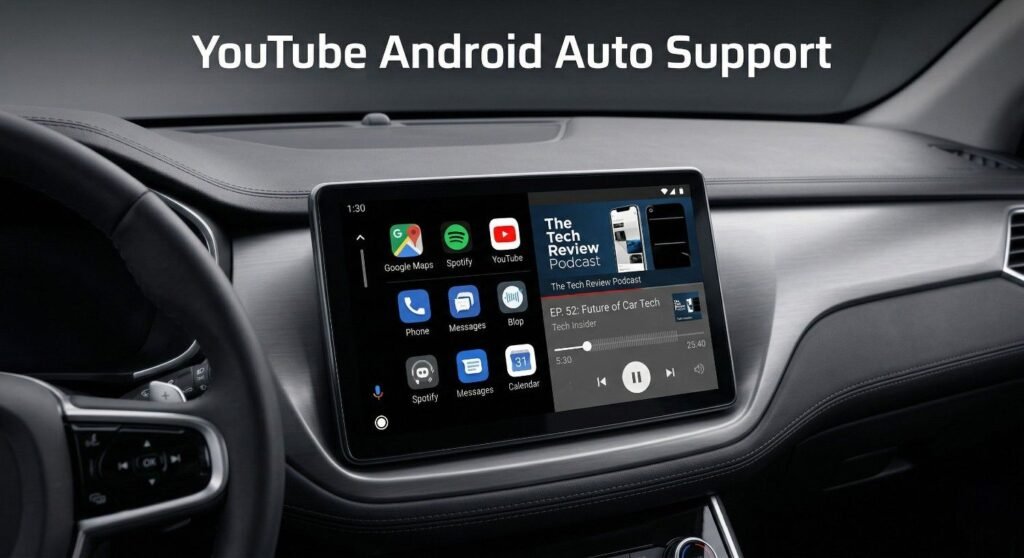
Why YouTube Android Auto Support Is Audio-Only
The most important detail about YouTube Android Auto support is that it does not allow video playback on the car’s screen while driving. Instead, the experience is limited to audio-only playback, aligning with broader automotive safety regulations that aim to minimize driver distraction.
This means that while users can play YouTube content through their car, they won’t actually see the video component. The system essentially treats YouTube like a podcast or music streaming service, focusing entirely on sound.
From a safety perspective, this approach makes sense. Visual distractions are a major concern in modern vehicles, and platforms like Android Auto are designed to ensure that drivers remain focused on the road. By restricting video playback, Google is adhering to these guidelines while still expanding functionality.
However, this also fundamentally changes how users interact with YouTube in a car setting. The platform becomes less about watching and more about listening.
Limited Controls Reflect a Safety-First Design
Beyond the absence of video, YouTube Android Auto support also introduces several interface limitations. Users can control playback through basic media controls, including play, pause, and skipping between videos. These controls are similar to what you would find in a music or podcast app.
What’s notably missing is deeper interaction. There is no traditional browsing interface that allows users to search, scroll, or explore content freely. This restriction is intentional, reducing the need for driver input and minimizing potential distractions.
Additionally, skipping within a video timeline appears to be restricted. Instead of jumping to a specific point, users can only move to the next video. This further simplifies the experience but may feel limiting for those accustomed to full YouTube functionality.
The Role of YouTube Premium in Android Auto
Another key aspect of YouTube Android Auto support is its dependency on background playback. Since the feature operates in an audio-only mode, it relies on YouTube’s ability to continue playing content without an active video interface.
This capability is typically tied to YouTube Premium, Google’s subscription service that enables background playback, ad-free viewing, and offline downloads. As a result, users without a Premium subscription may find that the feature is either unavailable or significantly restricted.
This requirement adds an additional layer to the rollout, effectively making YouTube Android Auto support more accessible to paying users while limiting functionality for those on the free tier.
A Shift Toward Audio-Centric Content Consumption
The introduction of YouTube Android Auto support reflects a broader shift in how content is consumed on the go. While YouTube has traditionally been a video-first platform, its growing library of podcasts, interviews, news segments, and long-form discussions makes it well-suited for audio consumption.
In a car environment, these types of content become particularly valuable. Drivers are more likely to engage with spoken-word content that does not require visual attention. By adapting YouTube for this context, Google is effectively expanding its role in the in-car entertainment ecosystem.
This also positions YouTube as a competitor to established audio platforms, blurring the lines between video, podcasting, and music streaming.
Why the Rollout Feels Incomplete
Despite its potential, the current state of YouTube Android Auto support appears to be in an early or experimental phase. Reports indicate that the feature is not widely available and may require specific conditions to activate.
Users have noted inconsistencies in availability, suggesting that the rollout could be controlled through server-side updates rather than a standard app update. This approach allows Google to test the feature with a limited audience before expanding it more broadly.
However, it also means that the experience may not yet be fully optimized. Performance issues, missing features, and limited functionality are common in early-stage rollouts, and YouTube Android Auto support appears to be no exception.
How This Compares to Other Android Auto Apps
Android Auto already supports a wide range of audio-focused applications, including music streaming services and podcast platforms. In this context, YouTube’s integration feels like a natural extension rather than a disruptive addition.
What sets YouTube apart is its vast content library. Unlike traditional audio apps, YouTube offers a mix of professionally produced content and user-generated material, covering virtually every topic imaginable.
This diversity could make it a powerful addition to Android Auto, provided the user experience is refined and reliability is improved.
The Bigger Picture for Android Users
The arrival of YouTube Android Auto support highlights Google’s ongoing efforts to unify its ecosystem across devices. From smartphones to cars, the goal is to create a seamless experience that allows users to access their content wherever they are.
For Android users, this means greater flexibility and convenience. The ability to transition from watching a video on a phone to listening to it in a car aligns with modern usage patterns, where content consumption is increasingly fluid.
At the same time, the limitations of the current implementation underscore the challenges of adapting video platforms for in-car use. Balancing functionality with safety will remain a key consideration as the feature evolves.
Final Thoughts
YouTube Android Auto support is an intriguing development that opens new possibilities for in-car entertainment, but it is not without its compromises. By prioritizing safety and simplicity, Google has created a version of YouTube that fits within the constraints of the driving environment.
For now, the feature feels more like an extension of YouTube’s audio capabilities than a full-fledged app experience. Its success will depend on how well Google refines the interface, expands compatibility, and addresses current limitations.
As it stands, YouTube Android Auto support is a promising step forward—but one that still has room to grow.