
The premium tablet market is heating up again, and the Vivo Pad 6 Pro is shaping up to be one of the most ambitious entries in recent years. Ahead of its official debut, Vivo has revealed key details about its upcoming flagship tablet, positioning it as a serious competitor to devices like the iPad Pro and Samsung Galaxy Tab S9 Ultra.
With a massive battery, ultra-fast charging, and high-end hardware, the Vivo Pad 6 Pro isn’t just another Android tablet—it’s a clear attempt to redefine what a productivity-focused tablet can offer in today’s market.
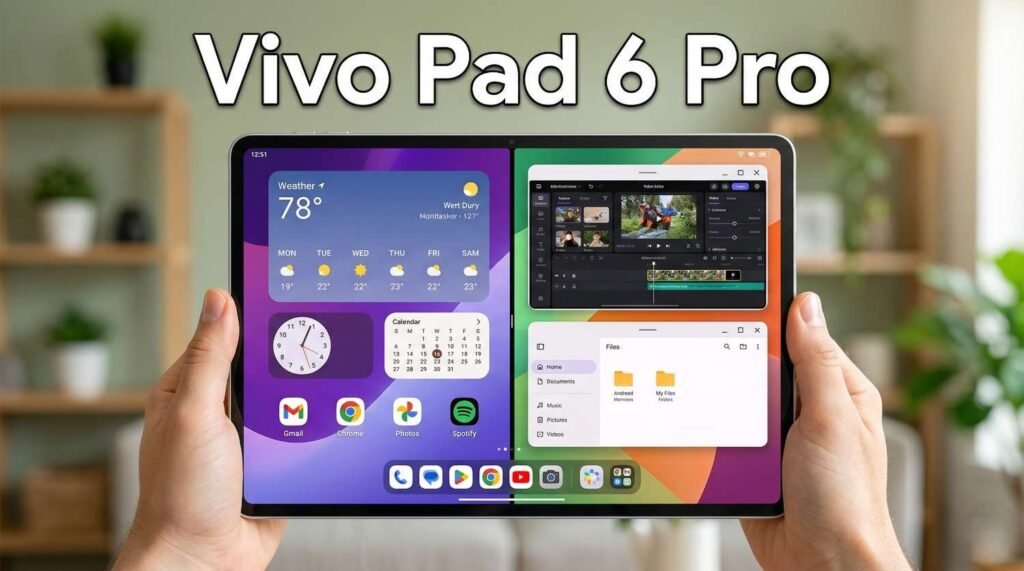
Vivo Pad 6 Pro Brings Flagship Specs to Tablets
The Vivo Pad 6 Pro stands out immediately with its hardware ambitions. At the center of the device is a large 13.2-inch 4K display designed to deliver sharp visuals and accurate color reproduction. Support for Dolby Vision further enhances its appeal for content creators and media consumers alike.
Under the hood, the tablet is powered by a next-generation Snapdragon chipset, placing it firmly in flagship territory. This level of performance ensures that the Vivo Pad 6 Pro can handle demanding workloads, from video editing to multitasking across multiple apps.
Unlike traditional tablets that lean heavily toward entertainment, Vivo is clearly positioning this device as a hybrid productivity machine.
A Massive Battery That Outclasses Rivals
One of the most talked-about features of the Vivo Pad 6 Pro is its enormous 13,000mAh battery.
This is significantly larger than what most premium tablets currently offer, including the iPad Pro. For users who rely on tablets during travel, work sessions, or extended media consumption, battery life is often a deciding factor—and this is where Vivo seems to be making a strong statement.
The large battery capacity means:
- Longer usage times without frequent charging
- Better support for high-performance tasks
- Increased reliability for on-the-go productivity
In practical terms, the Vivo Pad 6 Pro could become one of the most endurance-focused tablets in its class.
90W Fast Charging Changes the Game
Battery size alone isn’t enough—charging speed matters just as much. The Vivo Pad 6 Pro is expected to support up to 90W fast charging, a feature rarely seen in tablets.
This allows users to quickly top up the device, reducing downtime significantly. Compared to competitors, which often take hours to fully charge, Vivo’s approach offers a more flexible and efficient experience.
For professionals and frequent travelers, this combination of large battery and fast charging could be a major advantage.
Designed for Productivity, Not Just Entertainment
The Vivo Pad 6 Pro is clearly built with productivity in mind. Vivo has integrated PC-grade applications such as WPS Office and advanced video editing tools, turning the tablet into a capable workstation.
Additionally, the device supports accessories like:
- Keyboard attachments for typing
- Stylus input for note-taking and design
These features bring it closer to a laptop-like experience, making it suitable for tasks beyond casual use.
Display and Performance: Built for Power Users
The display is expected to support a high refresh rate, potentially reaching 144Hz. This ensures smoother scrolling, better responsiveness, and an overall premium user experience.
Combined with its powerful chipset, the Vivo Pad 6 Pro is designed to handle:
- Multitasking with multiple apps
- Creative workflows such as editing and design
- High-resolution media playback
This level of performance puts it in direct competition with top-tier tablets from both Apple and Samsung.
How It Compares to iPad Pro and Galaxy Tab
When compared to the iPad Pro, the Vivo Pad 6 Pro offers a clear advantage in battery capacity and charging speed. Apple’s ecosystem remains a strong selling point, but Vivo is competing aggressively on hardware.
Against the Samsung Galaxy Tab S9 Ultra, Vivo’s tablet stands out with its battery and potentially faster charging, while Samsung maintains strengths in display quality and ecosystem integration.
This creates an interesting dynamic:
- Vivo focuses on raw power and endurance
- Apple emphasizes ecosystem and optimization
- Samsung balances hardware and software features
Availability and Global Market Questions
One of the biggest questions surrounding the Vivo Pad 6 Pro is its availability outside China.
While the device has been showcased at international events, Vivo has not yet confirmed a full global rollout. For US consumers, this raises important considerations:
- Will the tablet be officially available?
- Will it support Google services globally?
- How will pricing compare to competitors?
These factors will play a crucial role in determining its success in international markets.
A New Direction for Android Tablets?
The Vivo Pad 6 Pro reflects a broader shift in the Android tablet space. Manufacturers are moving away from purely entertainment-focused devices and toward productivity-driven experiences.
This includes:
- Larger displays
- More powerful chipsets
- Enhanced software capabilities
As a result, tablets are increasingly positioned as laptop alternatives rather than secondary devices.
Final Thoughts
The Vivo Pad 6 Pro represents one of the most compelling Android tablet launches in recent memory. With its massive battery, ultra-fast charging, and productivity-focused design, it challenges established players in meaningful ways.
While questions around global availability remain, the device signals Vivo’s intent to compete at the highest level of the tablet market.
For users looking beyond traditional options like the iPad Pro or Galaxy Tab series, the Vivo Pad 6 Pro could be a serious contender—especially if it reaches international markets.