
The global smartphone industry is undergoing a major shift, and the smartphone price increase 2026 trend is now impossible to ignore. After years of steady declines in device pricing driven by scale, competition, and manufacturing efficiency, the market is moving in the opposite direction. From entry-level Android devices to premium flagships, prices are rising across the board—impacting consumers in India, the US, and beyond.
Recent industry data and trade insights suggest that what was once considered an affordable 5G smartphone is rapidly becoming out of reach for budget-conscious buyers. The implications go far beyond just pricing; they signal a structural change in how smartphones are manufactured, priced, and sold in the coming years.
Entry-Level Android Phones Are No Longer Cheap
One of the most striking aspects of the smartphone price increase 2026 phenomenon is the rapid escalation in entry-level device pricing. In markets like India, where affordability has traditionally driven smartphone adoption, the shift is especially noticeable.
Just a few months ago, during the festive season, entry-level 5G smartphones were widely available below ₹10,000. Fast forward to early 2026, and those same devices are now retailing between ₹13,000 and ₹14,000. Industry projections indicate that prices could soon climb to ₹17,000–₹18,000, with some models potentially approaching ₹20,000 within the next quarter.
This reversal effectively takes pricing back to levels seen several years ago, undoing a long-standing trend where technology became progressively cheaper over time. For first-time buyers and users upgrading from older devices, the barrier to entry is rising significantly.
What’s Driving the Smartphone Price Increase 2026 Trend?
The reasons behind the smartphone price increase 2026 are complex and interconnected. At the core lies a surge in component costs, particularly memory chips, which have seen sustained price hikes over the past several months. These components are essential to modern smartphones, powering everything from multitasking to AI-driven features.
Manufacturers that once absorbed such increases to maintain competitive pricing are now passing those costs directly to consumers. The pressure has intensified due to global economic factors, including currency fluctuations. In markets like India, the weakening rupee has made imports more expensive, further amplifying the cost burden.
Geopolitical tensions have also contributed to supply chain disruptions, increasing logistics costs and reducing predictability in component availability. Together, these factors are reshaping the economics of smartphone production.
Android Brands Are Raising Prices Aggressively
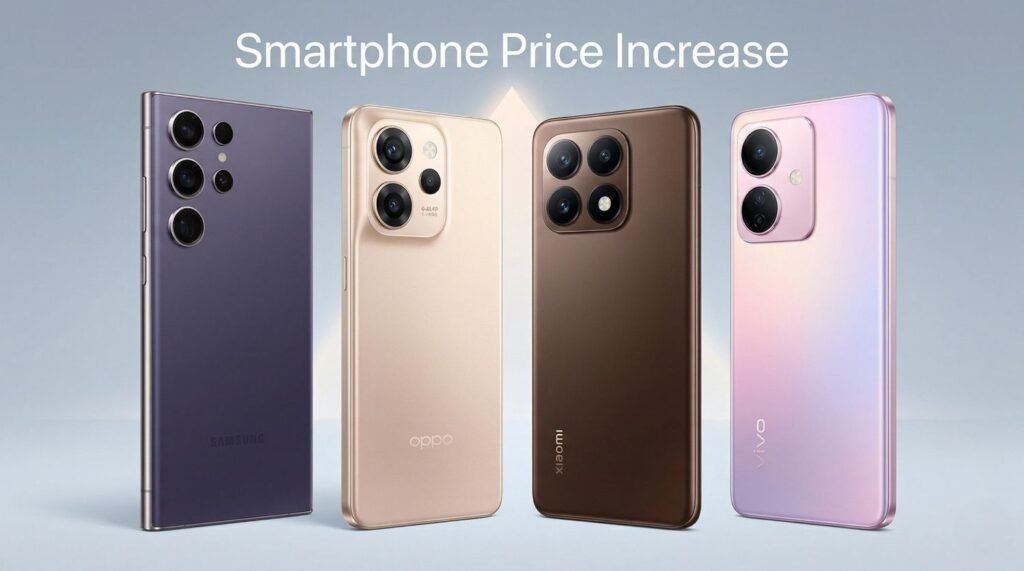
Major Android manufacturers are already adjusting their pricing strategies in response to these pressures. Companies like Samsung, Vivo, Oppo, and Xiaomi have reportedly indicated multiple rounds of price hikes across their portfolios.
What’s particularly notable is that some newer models are launching at significantly higher prices than their predecessors despite offering similar specifications. In certain cases, price increases of up to 30–35 percent have been observed, suggesting that brands are prioritizing margin protection over aggressive pricing.
This marks a departure from the traditional Android playbook, where competition drove prices down and innovation was used as a differentiator. In 2026, survival and sustainability appear to be taking precedence.
Discounts and Cashback Offers Are Disappearing
Another subtle but impactful change tied to the smartphone price increase 2026 trend is the disappearance of discounts, cashback offers, and seasonal deals. Historically, these incentives played a crucial role in making smartphones more accessible, especially in price-sensitive markets.
Retailers and industry insiders indicate that such promotional strategies have been significantly scaled back in recent months. Without these discounts, the effective cost of purchasing a smartphone has increased even further—often by an additional 10 percent.
This shift is reshaping consumer expectations and purchasing behavior, as buyers can no longer rely on festive sales or promotional offers to secure better deals.
Demand Is Starting to Feel the Pressure
As prices rise, demand is beginning to show signs of strain. Retailers report that consumers are becoming more cautious, with many opting to delay upgrades or explore alternative options.
One emerging trend is the growing popularity of refurbished and second-hand smartphones. These devices offer a more affordable entry point, allowing users to access higher-end features at a fraction of the cost. At the same time, some consumers are holding onto their existing devices for longer, extending upgrade cycles beyond the typical two to three years.
This behavioral shift could have long-term implications for the industry, potentially slowing overall sales growth and forcing brands to rethink their strategies.
Apple vs Android: Who Is Handling Price Hikes Better?
While Android brands are grappling with rising costs, Apple has taken a slightly different approach. The company continues to position its products at premium price points, relying on brand loyalty and ecosystem integration to justify higher costs.
However, even Apple is not immune to the broader smartphone price increase 2026 trend. Its entry-level offerings are no longer as “affordable” as they once were, and the gap between budget and premium devices continues to widen.
For Android manufacturers, the challenge is more pronounced. Competing on value has always been a core strength, but rising costs are eroding that advantage. As a result, the distinction between mid-range and flagship devices is becoming increasingly blurred.
The Bigger Picture: A Shift in Consumer Tech Economics
The smartphone price increase 2026 trend is not occurring in isolation. It reflects a broader shift in consumer electronics, where prices for televisions, appliances, and other devices are also rising.
For years, technological advancements and economies of scale drove prices downward, making devices more accessible to a global audience. That era may be coming to an end. Instead, the industry is entering a phase where innovation comes at a higher cost, and consumers must adjust their expectations accordingly.
Governments and industry bodies are beginning to take notice. In India, there have been calls to reduce GST on smartphones priced below ₹20,000 to support demand and maintain affordability. Whether such measures will be implemented remains to be seen, but they highlight the growing concern around rising tech costs.
What This Means for Buyers in 2026
For consumers, the smartphone price increase 2026 reality requires a more strategic approach to purchasing decisions. Buyers may need to prioritize features more carefully, weigh the benefits of upgrading, and consider alternative options such as refurbished devices or slightly older models.
The days of frequent upgrades driven by minor improvements may be fading. Instead, longevity, durability, and real-world performance are becoming more important factors in the decision-making process.
Final Thoughts
The smartphone price increase 2026 trend marks a turning point for the global smartphone industry. What was once a market defined by rapid innovation and falling prices is now facing a new set of challenges driven by rising costs and shifting economic conditions.
For Android users, this shift is particularly significant. The value proposition that once defined the platform is evolving, forcing both manufacturers and consumers to adapt. While innovation continues, it now comes with a higher price tag—one that may redefine how we think about smartphones in the years ahead.