
In a move that could significantly improve cross-platform usability, Samsung is expanding its Samsung Quick Share AirDrop functionality to older Galaxy smartphones. The update, which initially debuted on newer flagship devices, is now gradually reaching previous-generation models—marking an important step toward bridging the long-standing gap between Android and Apple ecosystems.
The Samsung Quick Share AirDrop feature is designed to allow Galaxy users to share files directly with Apple devices using an AirDrop-like experience. While Android has long had its own sharing solutions, seamless compatibility with Apple’s ecosystem has remained limited. This update aims to change that, at least in part.
However, despite the excitement surrounding the rollout, early reports suggest that the experience is still inconsistent and far from fully polished.
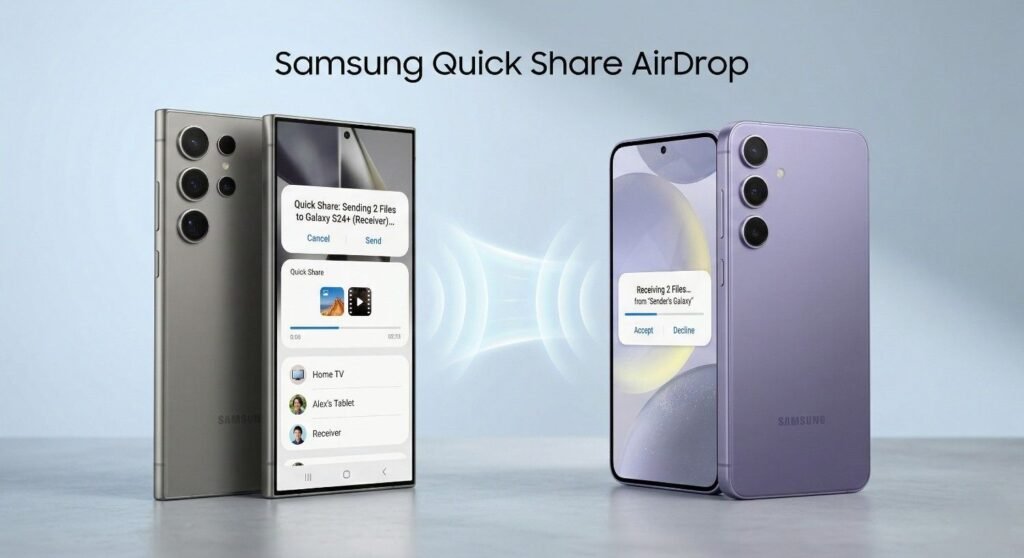
Samsung Quick Share AirDrop Compatibility: Which Devices Are Getting It?
The Samsung Quick Share AirDrop rollout is currently being spotted on several high-end Galaxy devices from recent years. These include the Samsung Galaxy S22, Samsung Galaxy S23, Samsung Galaxy S24, Samsung Galaxy S25, and the foldable Samsung Galaxy Z Fold 7.
Importantly, the feature appears to be tied to devices running the One UI 8.5 beta, suggesting that this is still part of a testing phase rather than a stable public rollout. Users who have installed the latest system updates, along with updated versions of Quick Share and Google Play services, are more likely to see the new option appear.
Even then, availability is inconsistent. Some users report seeing a new sharing option specifically for Apple devices, while others do not have access at all—highlighting the phased nature of the deployment.
A Long-Awaited Bridge Between Android and Apple
The introduction of Samsung Quick Share AirDrop support represents a notable shift in how Android manufacturers are approaching interoperability. For years, Apple’s AirDrop has been one of the most convenient features within its ecosystem, allowing effortless file transfers between iPhones, iPads, and Macs.
Android users, on the other hand, have relied on alternatives like Quick Share and other wireless transfer tools, which work well within the Android ecosystem but fall short when interacting with Apple devices.
By enabling Samsung Quick Share AirDrop functionality, Samsung is effectively reducing friction for users who operate in mixed-device environments. This is particularly relevant in markets where consumers frequently use both Android and Apple products, whether for personal or professional purposes.
Early Performance Issues Highlight an Incomplete Rollout
Despite its potential, the current implementation of Samsung Quick Share AirDrop is not without problems. Early adopters report that the feature often fails to function as intended.
In many cases, nearby Apple devices do not appear in the sharing interface, and Samsung devices are not detected within Apple’s AirDrop menu. This lack of reliability undermines the core purpose of the feature, which is to provide a seamless and intuitive file-sharing experience.
The inconsistency suggests that the rollout is being controlled through a combination of software updates and server-side activation. Users may need to update multiple components—including system firmware and Google services—before the feature becomes visible, and even then, functionality is not guaranteed.
This staged approach indicates that Samsung is still refining the feature before a broader release.
Samsung’s Strategy in a Changing Ecosystem Landscape
The expansion of Samsung Quick Share AirDrop aligns with a broader industry trend toward improved cross-platform compatibility. As consumers increasingly use multiple devices across different ecosystems, the demand for seamless interaction has grown.
Interestingly, Google has already taken steps in this direction with its Pixel devices, introducing enhanced file-sharing capabilities that aim to rival AirDrop. Samsung’s move can be seen as a response to this shift, ensuring that Galaxy devices remain competitive in terms of usability and convenience.
At the same time, Apple continues to maintain tight control over its ecosystem, prioritizing integration within its own product lineup. While Samsung’s approach does not fully replicate the native AirDrop experience, it represents a meaningful step toward greater openness.
Why This Feature Matters More Than Specs
In an era where smartphone hardware improvements are becoming incremental, features like Samsung Quick Share AirDrop carry significant weight. They address real-world usability challenges rather than focusing solely on specifications.
For many users, the ability to quickly and reliably transfer files between devices can be more valuable than marginal gains in processing power or camera performance. Whether sharing documents, photos, or videos, a seamless experience saves time and reduces frustration.
This makes cross-platform sharing one of the most impactful quality-of-life improvements in recent years, particularly for users who frequently switch between Android and Apple devices.
What Users Should Expect Next
As the Samsung Quick Share AirDrop rollout continues, it is likely that the company will address current limitations through software updates. Stability, device detection, and transfer reliability will be key areas of focus before the feature reaches a wider audience.
Users with compatible devices are encouraged to keep their software up to date and monitor future updates. However, those who rely heavily on cross-platform file sharing may want to wait until the feature is fully stable before depending on it in critical scenarios.
Final Thoughts
The expansion of Samsung Quick Share AirDrop to older Galaxy devices is a promising development that highlights the evolving priorities of the smartphone industry. By focusing on interoperability and user experience, Samsung is addressing one of the most persistent challenges in mobile computing.
While the current rollout is uneven and still in its early stages, the long-term implications are significant. If fully realized, this feature could redefine how users interact across ecosystems, making device boundaries less restrictive.
For now, the Samsung Quick Share AirDrop feature stands as a work in progress—but one with the potential to become a defining capability for Galaxy devices in the years ahead.