
Introduction
NFC vs Bluetooth Accessories is a key comparison for anyone exploring modern wireless technologies in smartphones, wearables, and smart devices. While both technologies enable wireless communication, they serve very different purposes in terms of speed, range, power consumption, and usability.
As wireless ecosystems grow, understanding the differences between NFC (Near Field Communication) and Bluetooth becomes essential for selecting the right accessories—whether it’s for audio streaming, contactless payments, or quick device pairing. This guide provides a comprehensive, expert-level breakdown of both technologies and their real-world applications.
What Is NFC Technology?
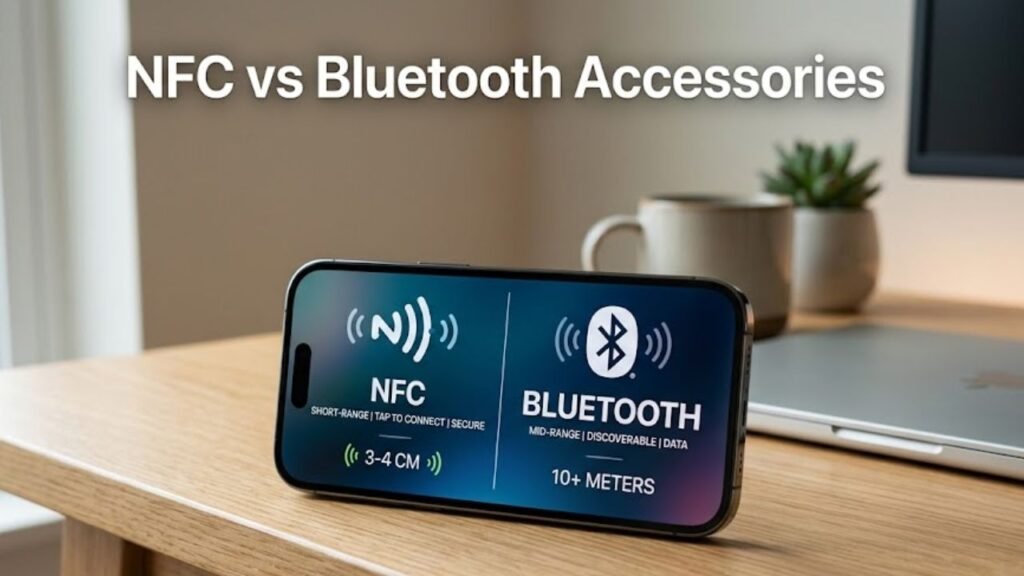
NFC (Near Field Communication) is a short-range wireless communication technology that allows devices to exchange data when placed very close together—typically within 4 cm.
Key Characteristics of NFC
- Extremely short range (a few centimeters)
- Instant connection without manual pairing
- Low power consumption
- Secure communication
Common Uses of NFC
- Contactless payments
- Access cards and smart locks
- Quick device pairing
- Data sharing
What Is Bluetooth Technology?
Bluetooth is a wireless communication standard designed for medium-range data transmission between devices.
Key Characteristics of Bluetooth
- Range up to 10 meters or more
- Continuous data transmission
- Supports audio and file transfer
- Widely compatible across devices
Common Uses of Bluetooth
- Wireless headphones and speakers
- Smartwatches and fitness trackers
- File sharing between devices
- IoT device connectivity
NFC vs Bluetooth Accessories: Core Differences
Understanding the differences between NFC vs Bluetooth Accessories helps clarify their unique roles.
Comparison Table
| Feature | NFC Accessories | Bluetooth Accessories |
|---|---|---|
| Range | ~4 cm | Up to 10–100 meters |
| Connection Speed | Instant | Requires pairing |
| Power Consumption | Very low | Moderate |
| Data Transfer Speed | Low | High |
| Use Cases | Payments, pairing | Audio, data transfer |
| Security | High (short range) | Moderate (encrypted) |
Range and Connectivity
NFC Range
NFC works only at very close distances, making it ideal for secure and intentional interactions.
Bluetooth Range
Bluetooth offers much greater range, allowing devices to stay connected across rooms or even larger spaces.
Key Insight
If you need continuous connectivity, Bluetooth is essential. For quick, secure interactions, NFC is superior.
Speed and Data Transfer
NFC Speed
NFC supports low data transfer rates, typically up to 424 kbps. It is not designed for large data transfers.
Bluetooth Speed
Bluetooth can handle significantly higher speeds, especially with newer versions like Bluetooth 5.x.
Practical Impact
- NFC: Best for small data exchanges
- Bluetooth: Ideal for streaming and file transfers
Power Consumption Comparison
NFC Efficiency
NFC consumes minimal power and can even operate without a battery in passive devices.
Bluetooth Consumption
Bluetooth uses more power, especially during continuous data transmission.
Low Energy Bluetooth (BLE)
BLE reduces power usage significantly, making it suitable for wearables.
Security Considerations
NFC Security
- Short range reduces interception risk
- Requires close physical proximity
- Commonly used in secure applications
Bluetooth Security
- Uses encryption protocols
- Vulnerable if not properly configured
- Requires pairing authentication
Ease of Use and User Experience
NFC Simplicity
- Tap-and-go functionality
- No manual setup required
Bluetooth Convenience
- Requires initial pairing
- Automatically reconnects afterward
User Preference
NFC is faster for one-time actions, while Bluetooth is better for ongoing connections.
Real-World Applications of NFC vs Bluetooth Accessories
Smartphones
- NFC: Payments, quick pairing
- Bluetooth: Audio streaming, file sharing
Wearables
- NFC: Contactless payments in smartwatches
- Bluetooth: Continuous data syncing
Smart Home Devices
- NFC: Initial setup
- Bluetooth: Ongoing control
Advantages of NFC Accessories
1. Instant Connectivity
No pairing process required.
2. High Security
Short range minimizes risk.
3. Low Power Usage
Efficient for battery-powered devices.
4. Simple User Experience
Tap-and-use functionality.
Advantages of Bluetooth Accessories
1. Long Range
Works across rooms and spaces.
2. High Data Transfer
Supports audio and large files.
3. Continuous Connection
Ideal for streaming and real-time communication.
4. Wide Compatibility
Supported by most modern devices.
Limitations of NFC Accessories
Limited Range
Only works at very close distances.
Low Data Speed
Not suitable for large data transfers.
Limitations of Bluetooth Accessories
Higher Power Consumption
Consumes more battery than NFC.
Pairing Complexity
Initial setup can be time-consuming.
NFC vs Bluetooth Accessories: Which Should You Choose?
Choose NFC Accessories If You Need:
- Secure transactions
- Instant connections
- Low power usage
Choose Bluetooth Accessories If You Need:
- Audio streaming
- Long-range connectivity
- Continuous data transfer
Practical Tips for Choosing the Right Technology
1. Define Your Use Case
Identify whether you need short-range or long-range communication.
2. Consider Battery Life
Choose NFC for minimal power usage, Bluetooth for functionality.
3. Evaluate Security Needs
NFC is better for sensitive transactions.
4. Check Device Compatibility
Ensure your devices support the required technology.
5. Look for Hybrid Devices
Some accessories support both NFC and Bluetooth for flexibility.
Future Trends in NFC and Bluetooth Technologies
NFC Evolution
- Wider adoption in payments and digital identity
- Integration with smart environments
Bluetooth Advancements
- Improved range and speed
- Enhanced low-energy performance
- Better integration with IoT ecosystems
Common Myths About NFC vs Bluetooth Accessories
Myth 1: NFC Can Replace Bluetooth
Reality: NFC complements Bluetooth but cannot replace it.
Myth 2: Bluetooth Is Always Better
Reality: It depends on the use case.
Myth 3: NFC Is Only for Payments
Reality: It has multiple applications beyond payments.
FAQs
1. What is the main difference between NFC and Bluetooth?
NFC is for short-range, instant communication, while Bluetooth supports longer-range, continuous connections.
2. Which is faster: NFC or Bluetooth?
Bluetooth offers higher data transfer speeds.
3. Is NFC more secure than Bluetooth?
Yes, due to its short range and proximity requirement.
4. Can NFC and Bluetooth work together?
Yes, NFC is often used to initiate Bluetooth pairing.
5. Which consumes less battery?
NFC consumes significantly less power than Bluetooth.
Conclusion
NFC vs Bluetooth Accessories is not about choosing one over the other—it is about understanding their strengths and using them appropriately. NFC excels in quick, secure, and low-power interactions, making it ideal for payments and instant connections. Bluetooth, on the other hand, dominates in continuous communication, high-speed data transfer, and long-range connectivity.
As wireless technology continues to evolve, both NFC and Bluetooth will play complementary roles in shaping connected ecosystems. By understanding their differences and applications, users can make informed decisions and maximize the performance of their devices and accessories.