
Samsung has officially unveiled the Galaxy S26 privacy display, and it might be the most practical flagship feature we’ve seen in years. While most smartphone launches focus on camera upgrades and chipset benchmarks, this new pixel-level privacy technology takes a different approach — solving a real-world problem millions of users deal with every day.
With the debut of the Samsung Galaxy S26, Samsung Electronics is introducing a built-in screen privacy layer that eliminates the need for aftermarket privacy screen protectors. And unlike traditional film-based solutions, this one can be toggled on or off instantly.
For commuters, office workers, and frequent travelers, this could be a game-changer.
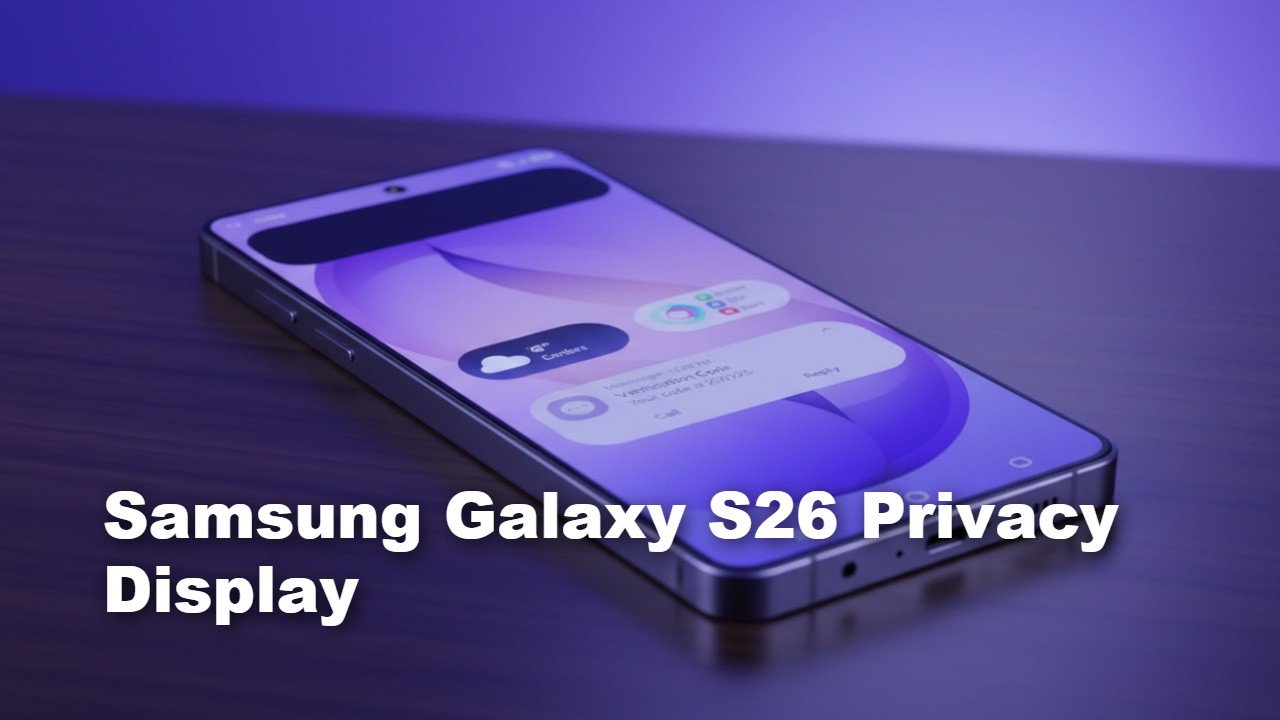
Galaxy S26 Privacy Display: How the Technology Works
At the core of the Galaxy S26 privacy display is a redesigned pixel architecture. Instead of relying on a physical filter placed over the screen, Samsung has engineered the display itself to control viewing angles dynamically.
Here’s the breakdown:
- Half of the display pixels emit a focused beam directed straight at the user
- The remaining pixels function normally for wide-angle viewing
- When privacy mode is activated, only the focused-beam pixels are used
- Side viewing angles become significantly darker and unreadable
The result? Anyone glancing at your phone from the side sees a dim or obscured screen, while you retain a clear forward-facing view.
Unlike privacy screen protectors, this system:
- Doesn’t permanently reduce brightness
- Doesn’t distort color reproduction when turned off
- Can be enabled selectively
That last point is where things get especially interesting.
App-Level Privacy Control Is the Real Innovation
The Galaxy S26 privacy display doesn’t just function as an all-or-nothing toggle. Samsung allows users to apply privacy mode to specific apps — or even certain areas of the screen.
For example:
- Keep your main display visible
- Darken notification banners from side angles
- Shield banking apps or messaging conversations
- Protect sensitive documents while browsing
This area-specific filtering makes it far more flexible than any third-party screen protector.
If you’re checking emails on a flight or replying to messages on a train, you no longer need to physically adjust your phone angle to avoid prying eyes.
Why This Matters in the Samsung vs Apple Rivalry
The smartphone market is increasingly defined by ecosystem loyalty. Android vs iOS comparisons typically revolve around camera performance, processor power, or software features.
But the Galaxy S26 privacy display introduces something neither current iPhone models nor most Android competitors offer natively.
Interestingly, Samsung is a major supplier of OLED panels used in iPhones. In theory, similar display-layer privacy technology could appear on future Apple devices. However, implementing a pixel-level brightness tradeoff — which slightly reduces sharpness when privacy mode is active — may not align with Apple’s traditional display philosophy.
For now, this is a Samsung-exclusive innovation.
The Trade-Off: Brightness vs Privacy
No technology comes without compromise. When the Galaxy S26 privacy display is enabled, only half of the pixel output is active. That means:
- Slightly reduced brightness
- Minor sharpness drop
- Lower overall luminance
However, because the feature is optional and app-based, users can switch it off whenever full display performance is needed — such as streaming video or gaming.
This flexibility makes it significantly more appealing than permanent matte privacy filters.
More Than Just a Gimmick
The Galaxy S26 itself packs flagship hardware, including:
- A large QHD+ AMOLED display
- Next-generation Snapdragon processor
- High-resolution multi-camera system
- Advanced AI optimization features
But the privacy display could become the defining headline feature of this model cycle.
In an era where smartphones increasingly contain sensitive financial, professional, and personal data, built-in privacy at the hardware level makes strategic sense.
It also aligns with growing global awareness around digital security and public data exposure.
Could This Expand to Other Samsung Devices?
Given Samsung’s control over its display manufacturing pipeline, it’s reasonable to expect this technology could extend beyond smartphones.
Potential future applications include:
- Galaxy tablets
- Foldables
- Business-focused devices
- Even laptops
If adopted widely, Samsung could establish a new hardware privacy standard across its ecosystem.
Final Thoughts
The Galaxy S26 privacy display is not a flashy spec-sheet number. It won’t show up in benchmark charts. But it solves a daily annoyance in a way that feels distinctly premium.
In a market crowded with incremental upgrades, that’s exactly the kind of feature that stands out.