
Introduction
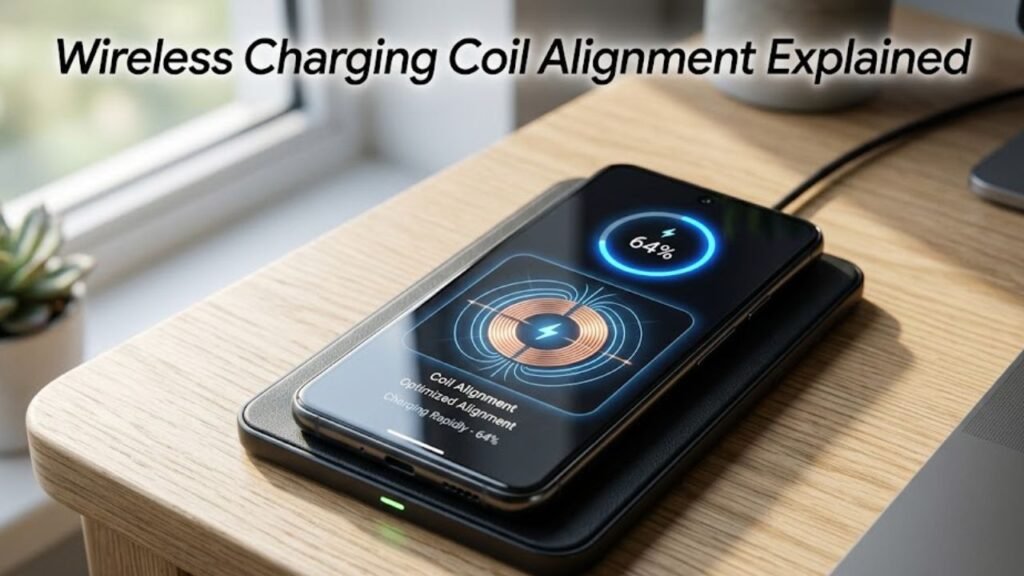
Wireless Charging Coil Alignment Explained is a critical concept for understanding why some devices charge efficiently while others charge slowly—or not at all—on wireless chargers. As wireless charging becomes more common in smartphones, earbuds, and wearables, coil alignment plays a decisive role in performance.
At its core, wireless charging relies on electromagnetic induction between two coils. If these coils are not properly aligned, energy transfer becomes inefficient, leading to slower charging speeds, increased heat, and wasted power. This guide explores the science, practical implications, and optimization strategies for coil alignment in modern wireless charging systems.
What Is Wireless Charging?
Wireless charging is a method of transferring energy between two objects without physical connectors. It uses electromagnetic fields generated by coils inside both the charger and the device.
Basic Components
- Transmitter coil (inside the charging pad)
- Receiver coil (inside the device)
- Power source
- Control circuitry
How It Works
When current flows through the transmitter coil, it creates a magnetic field. This field induces current in the receiver coil, which charges the device’s battery.
Understanding Coil Alignment in Wireless Charging
Wireless Charging Coil Alignment Explained revolves around how precisely the transmitter and receiver coils are positioned relative to each other.
What Is Coil Alignment?
Coil alignment refers to the positioning of the charging pad’s coil directly beneath the device’s internal coil.
Why Alignment Matters
- Maximizes energy transfer efficiency
- Reduces charging time
- Minimizes heat generation
- Improves overall charging stability
Types of Coil Alignment
Perfect Alignment
- Coils are directly centered
- Maximum efficiency achieved
- Fastest charging speeds
Partial Alignment
- Coils overlap partially
- Reduced efficiency
- Slower charging
Misalignment
- Coils are offset significantly
- Minimal or no charging
- Increased heat generation
Coil Alignment Efficiency Table
| Alignment Type | Efficiency Level | Charging Speed | Heat Generation | Power Loss |
|---|---|---|---|---|
| Perfect | Very High | Fast | Low | Minimal |
| Partial | Moderate | Medium | Moderate | Noticeable |
| Misaligned | Low | Slow/None | High | Significant |
The Science Behind Coil Alignment
Electromagnetic Induction
Wireless charging works through electromagnetic induction, where energy transfer depends on magnetic field coupling between coils.
Coupling Coefficient
The coupling coefficient measures how effectively energy transfers between coils. Better alignment increases this value.
Distance and Positioning
Efficiency drops rapidly when:
- Distance between coils increases
- Coils are not centered
Impact of Misalignment on Charging Performance
1. Slower Charging Speeds
Misalignment reduces energy transfer, forcing the system to compensate with lower efficiency.
2. Increased Heat Generation
Energy loss during misalignment converts into heat, which can affect device safety.
3. Reduced Battery Health
Frequent overheating can degrade battery life over time.
Modern Solutions to Coil Alignment Issues
Magnetic Alignment (MagSafe Technology)
Magnetic systems automatically align the device with the charger for optimal performance.
Multi-Coil Charging Pads
These pads include multiple coils to reduce alignment sensitivity.
Smart Detection Systems
Advanced chargers detect device position and adjust power delivery accordingly.
Single Coil vs Multi-Coil Chargers
Single Coil Chargers
- Require precise placement
- Higher efficiency when aligned
- Lower cost
Multi-Coil Chargers
- More forgiving alignment
- Slightly lower efficiency
- Higher convenience
Wireless Charging Standards and Alignment
Qi Standard
The most widely used wireless charging standard defines alignment tolerances and efficiency requirements.
Qi2 and Future Standards
New standards aim to improve alignment through magnetic positioning and better coil design.
Design Factors Affecting Coil Alignment
Device Thickness
Thicker devices increase distance between coils, reducing efficiency.
Case Compatibility
Phone cases can interfere with alignment and energy transfer.
Coil Size and Shape
Larger coils provide better tolerance but may reduce precision.
Common Alignment Issues in Real-World Usage
Incorrect Placement
Users often place devices off-center, leading to poor charging performance.
Non-Compatible Chargers
Different standards or poor-quality chargers may worsen alignment issues.
Environmental Factors
Metal objects or interference can disrupt magnetic fields.
Advantages of Proper Coil Alignment
1. Maximum Charging Efficiency
Ensures optimal energy transfer.
2. Faster Charging Times
Reduces time required to reach full battery.
3. Lower Heat Output
Minimizes energy loss and overheating.
4. Improved Battery Longevity
Protects battery from thermal stress.
Limitations of Wireless Charging Coil Alignment
Placement Sensitivity
Precise positioning is often required.
Efficiency Loss
Wireless charging is inherently less efficient than wired charging.
Cost of Advanced Systems
Magnetic alignment and multi-coil systems increase cost.
Practical Tips to Improve Coil Alignment
1. Center Your Device
Always place your phone in the middle of the charging pad.
2. Use Magnetic Chargers
Magnetic alignment ensures perfect positioning.
3. Remove Thick Cases
Avoid cases that increase distance between coils.
4. Choose Quality Chargers
Certified chargers provide better alignment and efficiency.
5. Avoid Metal Interference
Keep metal objects away from charging area.
Future of Wireless Charging Coil Alignment
Magnetic Precision Systems
Future chargers will rely heavily on magnetic alignment for accuracy.
Higher Efficiency Designs
Improved coil materials and designs will reduce energy loss.
Long-Distance Wireless Charging
Emerging technologies may eliminate alignment constraints altogether.
Common Myths About Wireless Charging Coil Alignment
Myth 1: Placement Doesn’t Matter
Reality: Alignment directly impacts charging performance.
Myth 2: All Wireless Chargers Are Equal
Reality: Coil design and alignment technology vary significantly.
Myth 3: Wireless Charging Is Always Slow
Reality: Proper alignment can significantly improve speed.
FAQs
1. What is coil alignment in wireless charging?
It is the positioning of the charger coil and device coil for efficient energy transfer.
2. Why is my wireless charging slow?
Misalignment is one of the most common causes.
3. Do magnetic chargers improve alignment?
Yes, they automatically position coils for optimal efficiency.
4. Can a phone case affect alignment?
Yes, thick or metal cases can reduce efficiency.
5. Is perfect alignment necessary?
For best performance, proper alignment is highly recommended.
Conclusion
Wireless Charging Coil Alignment Explained highlights the critical role alignment plays in determining charging efficiency, speed, and safety. While wireless charging offers unmatched convenience, its performance depends heavily on precise coil positioning.
From electromagnetic principles to modern magnetic alignment systems, the evolution of this technology continues to improve user experience. By understanding how coil alignment works and applying practical optimization tips, users can significantly enhance their wireless charging performance.
As the industry moves toward smarter and more efficient solutions, mastering coil alignment will remain essential for getting the most out of wireless charging technology.