
OpenAI First Hardware Device Could Be an AI Audio Wearable
OpenAI is preparing to enter unfamiliar territory. After reshaping software, productivity, and developer workflows with ChatGPT and its latest GPT models, the company is now reportedly working on its first hardware product — and early leaks suggest it won’t be a smartphone or smart glasses.
According to multiple reports and a fresh leak surfacing from China, OpenAI’s first hardware device is expected to be a wearable AI-powered audio product, potentially in the form of smart earbuds codenamed “Dime.” If accurate, this move signals OpenAI’s ambition to build a new category of AI-native devices that operate alongside smartphones rather than replacing them.
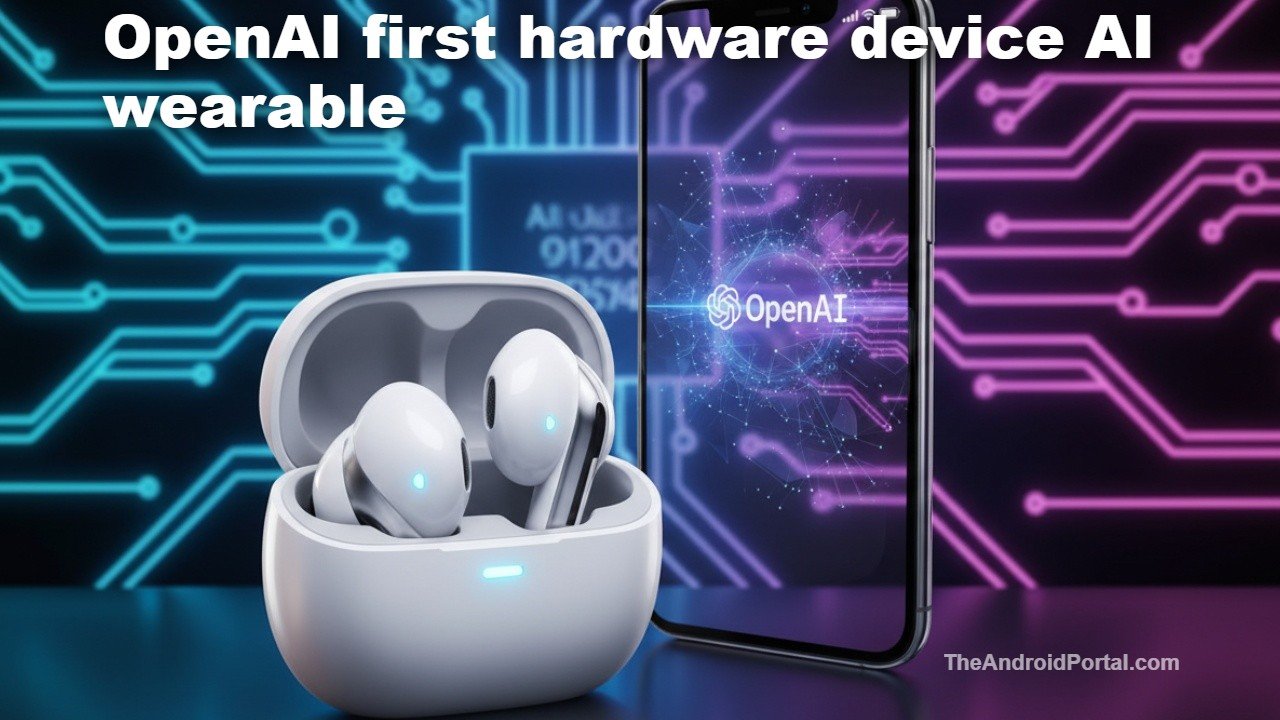
OpenAI First Hardware Device: What the Latest Leak Reveals
The leak, attributed to tipster Smart Pikachu, claims that OpenAI is developing a compact wearable audio device designed for continuous AI interaction. Unlike smartphones or XR wearables, the device would rely heavily on voice input, contextual awareness, and cloud-based intelligence.
A recently surfaced Chinese patent filing further strengthens the claim. The patent references the name “Dime,” which insiders believe could be the commercial branding for OpenAI’s debut hardware. While the documentation avoids explicit product imagery, the technical language aligns with earbuds-style wearables focused on AI-assisted audio interaction.
Importantly, sources suggest OpenAI may adopt a phased hardware strategy, launching a simpler model first to test real-world usage before rolling out more advanced AI features.
Why OpenAI Is Starting With an Audio Wearable
For OpenAI, launching an audio wearable makes strategic sense. Voice-first AI interactions are already core to ChatGPT usage, and earbuds offer a low-friction entry point into hardware without competing directly with Android smartphones.
Key reasons behind the audio-first approach:
- Lower production complexity compared to phones or AR glasses
- Always-on voice interaction aligns with AI assistants
- Easier integration with Android and iOS ecosystems
- Reduced dependency on displays and complex UI
Rather than becoming a phone alternative, OpenAI’s first hardware device could function as a personal AI layer that works across platforms — including Android smartphones, laptops, and wearables.
HBM Shortage May Delay OpenAI’s More Ambitious Hardware Plans
Interestingly, the same leak indicates that OpenAI may have originally planned a more phone-like AI computing device, but those ambitions appear delayed. The reason? A global shortage of High Bandwidth Memory (HBM) — a critical component for AI acceleration.
HBM prices have surged due to demand from data centers and AI chips, significantly raising hardware costs. As a result, OpenAI is reportedly prioritizing a cost-efficient wearable for its initial launch, while more advanced SKUs could arrive later once component pricing stabilizes.
This mirrors strategies used by Android OEMs that test new categories with limited releases before scaling globally.
How This Could Impact the Android Ecosystem
While not an Android product itself, OpenAI’s entry into hardware has direct implications for Android users. An AI audio wearable designed around voice commands could integrate deeply with Android phones, Google services, and third-party apps.
Potential Android use cases include:
- Hands-free AI assistance across apps
- Context-aware reminders and summaries
- Real-time translation and transcription
- Smart notifications without screen dependence
If OpenAI opens APIs or partnerships, Android manufacturers could eventually bundle or support the device natively, creating competition for Google Assistant and other AI layers.
OpenAI Hardware Arrives as GPT Models Grow More Powerful
The hardware push comes at a pivotal moment for OpenAI. The company recently rolled out GPT-5.3-Codex, a faster and more capable AI model designed for agentic workflows, coding, content creation, and system-level automation.
Embedding such models into a wearable could redefine how users interact with AI — shifting from reactive prompts to ambient intelligence that listens, learns, and responds proactively.
That vision aligns closely with industry trends, where AI is moving away from screens and toward continuous, voice-driven experiences.
What to Expect Next
While OpenAI hasn’t officially confirmed the product name or form factor, executives have publicly acknowledged plans to launch their first AI device this year. If the leaks are accurate, an announcement could arrive later in 2026, with limited-market availability initially.
For Android users, this is a story worth watching closely. Whether OpenAI’s hardware becomes a breakout success or a niche experiment, it represents a meaningful shift — AI companies no longer want to live only inside apps.